

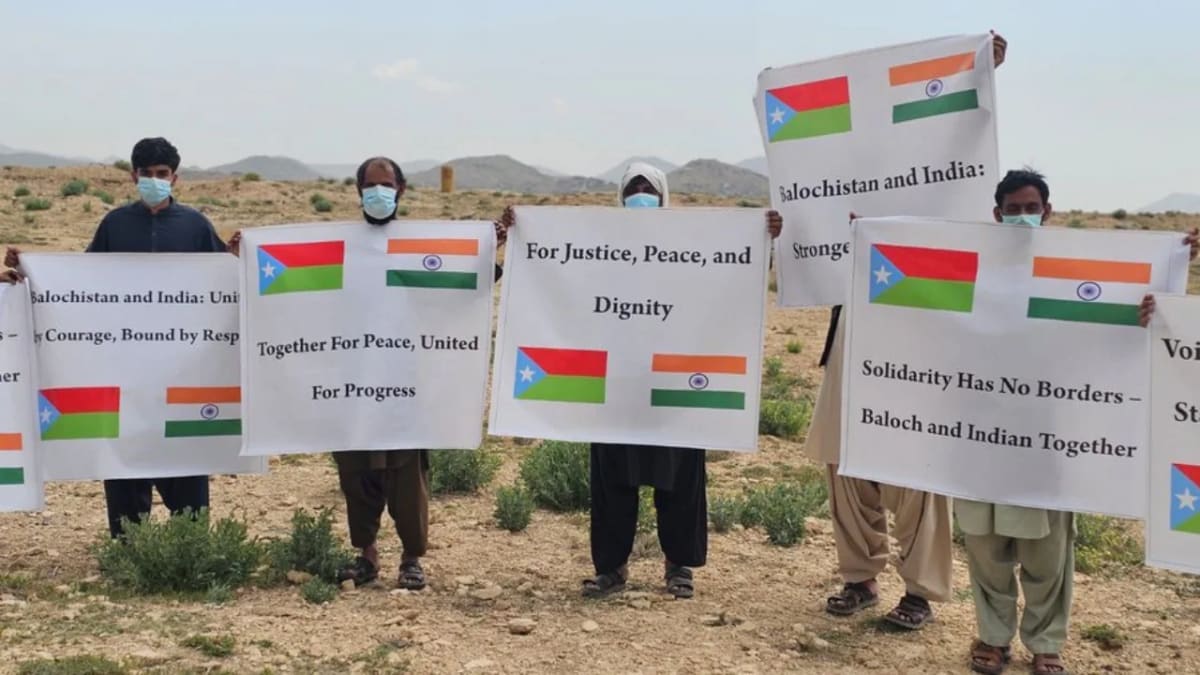
Balochistan Independence: Balochistan declared itself an independent nation on Wednesday, May 14. Mir Yar Baloch, a prominent activist and writer from Balochistan, shared several statements on social media last week, in which he announced the formation of the 'Republic of Balochistan'. Not only this, Mir Yar Baloch has sought recognition from the United Nations and India. He has raised the demand for opening an embassy in New Delhi. This has again increased tension in this region of Pakistan. Along with this, it has again drawn attention to the long-running insurgency in the troubled southwestern province of Balochistan.
Mir Yar Baloch appealed to the United Nations to recognise the declaration and provide funds for basic state functions, including issuing currency and passports. “The declaration should be made as soon as possible, as the collapse of terrorist Pakistan is near. We request India to allow the opening of an official office and embassy of Balochistan in Delhi,” he wrote on May 9. His statements were accompanied by photos of people waving Baloch flags and maps showing an independent Balochistan. The posts come amid growing calls from Baloch leaders for greater international involvement and support, especially from India.
Pakistan’s largest province by area
Balochistan is Pakistan’s largest province by area. It was part of the princely state of Kalat before it was annexed by Pakistan in 1948. The move triggered an insurgency, with nationalist groups demanding greater autonomy or independence. Frequent military operations by Pakistan led to repeated cycles of revolt and repression. Human rights organizations have reported enforced disappearances, extrajudicial killings and the targeting of civilians. The recent killing of prominent Baloch rally driver Tariq Baloch, allegedly under a 'kill and dump' policy, has further escalated tensions.
Gwadar Port and Strategic Interests
Balochistan's strategic importance lies in the presence of the deep-water Gwadar Port, which is a key part of the China-Pakistan Economic Corridor (CPEC). The CPEC has brought billions of dollars of Chinese investment to Pakistan. Local communities say they have been denied the benefits and evicted from their land without proper compensation. The port and surrounding areas have been the target of repeated attacks by Baloch insurgents, some of whom have directly threatened Chinese personnel working on infrastructure projects.
People, Territory, Government and Sovereignty
According to the BBC English website, international law experts actually identify four main aspects for a state. These are people, territory, government and sovereignty. The ability to conduct relations with other states on the basis of these. The definition of a people is much debated, but it means a permanent population with a concept of and belief in their own nationhood. As James Irving, who teaches international law at the London School of Economics (LSE), puts it, “are relationships…, effective relationships, relationships of belonging, relationships of identity or of emotion. And also relationships related to practical shared interests.”
Territory and its governance
Another essential thing is that states must have a definite territory. An area within the borders which they rule. Another criterion for statehood is stated by many experts to be a stable and effective government. The ability to form and conduct relations with other states is another key element. Sovereign states are free to enter into bilateral relations. For example where two countries agree to diplomatic relations or work together to solve a common problem. They are free to enter into multilateral relations. The understanding behind this is that a sovereign state is neither dependent on nor subservient to any other power or state.
Getting UN recognition is important
Different countries can recognise each other, but the most important is to be recognised as a state by the United Nations. It has many benefits, including protection under international law, the ability to borrow from the World Bank and the IMF, control over borders and better access to economic networks and mechanisms. Apart from this, protection is provided by trade laws, which makes it easier to enter into trade agreements. But can you remain a state even if you are not recognised by the United Nations? According to the BBC, Rebecca Richards, professor of international relations at Keele University, says, "Basically it is an old saying. If someone walks like a duck and talks like a duck, then he is a duck. We believe that it is like a state, it just lacks recognition."
Know from the example of Somaliland
Somaliland is an example of this. It was a former British protectorate in East Africa. It remained independent for four days in 1960, after which it joined Italian Somalia. until the fall of the government in 1991 It remained a part of Somalia. After this, Somaliland unilaterally declared independence. According to a report, Rebecca Richards says, "It is a remarkably strong government. Elections were held democratically. There is a peaceful environment here. There is a stable environment here. There is incredible economic growth here. There is everything you would expect to see in a state here." But no one recognizes Somaliland, which has made life difficult there. Aid coming from the United Nations goes through Somalia. Access to international markets is difficult without legal protection. Since Somaliland's currency is not recognized outside its borders, it has no international value.
India's role in Balochistan
In recent weeks, Baloch activists have increased their reach to India. Mir Yar Baloch has demanded to rename the historic Jinnah House in Mumbai as 'Balochistan House', calling it a symbolic sign of support. Similar demands and messages of solidarity with India have also been circulated on social media. Although the declaration of independence is symbolic and has not received formal international support, it has important implications for regional stability. Experts have warned that this could encourage other separatist movements within Pakistan and make efforts to stabilize Balochistan more difficult. Professor Milena Sterio, who teaches international law at Cleveland State University in the US, says, "It is impossible for a group to become independent and obtain its own separate statehood unless other powerful states are willing to support it." That is why Balochistan is looking to India and the United Nations. The Pakistani government has not yet given any official reaction to the latest developments.

Discussion (0)
Leave A Reply
Speak Truth To PowerModerated by Times Indian