

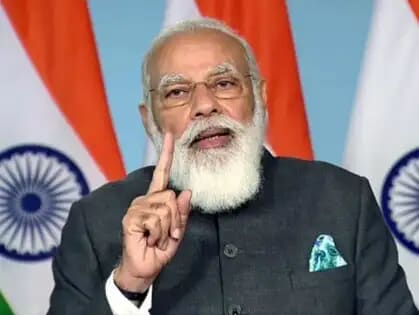
New Delhi: India needs to be alert about Bangladesh's growing closeness with China. In fact, Bangladesh Chief Advisor Mohammad Yunus is known to make his mark through networking. In such a situation, it is impossible that Mohammad Yunus was unaware of the consequences of his comments given on returning from China. His opinion about India's north-eastern states being landlocked and Bangladesh having 'ownership of the sea' can be seen as clumsy in the context of India-Bangladesh coordination. However, after the statement given about the Seven Sisters and China, Yunus left no room for ambiguity.
After the ouster of Sheikh Hasina's government in August last year, Bangladesh's interim administration has shown its closeness to Beijing while ignoring India. The new friendship with China is being seen as a matter of national pride in some parts of Bangladesh. This perception has been strengthened by the bilateral meeting between Yunus and Narendra Modi in Bangkok on Friday.
Yunus has one eye on the domestic political pitch
It cannot be denied that Yunus had one eye on his domestic political pitch. After the deterioration in law and order during the last few weeks and increasing tension between various forces united to oust the Awami League government, rumours of a military takeover of power in Bangladesh have gained momentum. On February 25, Army Chief General Waqar-uz-Zaman had publicly advised the interim administration to stop infighting and organize its work.
But this is easier said than done. It is becoming clear that Yunus relies on extremists who are part of his government and have even formed a political party of their own. These ‘student’ activists, considered to be sympathisers of the Islamists, have led a campaign to erase symbols of the 1971 Liberation War and create a second Islamic state centred on a 2024 uprising.
Ideological distortions fuelling anti-India sentiment
As was expected, these ideological distortions have fuelled a virulent anti-India sentiment. The attacks on Bangladesh’s Hindu minority were seen as targeting supporters of the former regime but the interim regime did not seem to do much to stop it.
The persistent harassment and imprisonment of Swami Chinmoy Prabhu in Bangladesh on charges of sedition is an attempt to send a message to Hindus to stay away from public life or face the consequences. Swami Chinmoy Prabhu is seen as a public enemy in Bangladesh because of his message to Hindus that they should stay in Bangladesh and fight for their rights rather than go to India.
India responds to Bangladesh in a unique way
India has responded to the turmoil in Bangladesh in a unique way. This includes the supply of food and consumer goods on which Bangladesh is most dependent. India has continued to supply consumer goods with minor interruptions. There has also been no disruption in the supply of yarn for Bangladesh's textile industry. However, India has cut down on visas, including medical visas, for Bangladeshis. Although some Bangladeshis are under the misconception that India's new visa regime has hurt Kolkata's economy, small traders such as Jamdani saree sellers and Bangladeshis coming to India to obtain third country visas have been worst affected.
Challenges for Delhi are both political and strategic
The challenges for Delhi in its relations with Dhaka are both political and strategic. Since India is of great importance to Bangladesh, every move taken by it is closely watched. For now, India would like to refrain from doing anything beyond the bare minimum. However, Pakistan's entry into the Bangladesh issue and Yunus's invitation to China to look at Bangladesh as an extension of its domestic market have put national security at the top of India's concerns.
Looking for alternative ways to secure eastern India
In all fairness, India should wait for the ties with the elected government in Bangladesh to strengthen. Although there are no signs that the interim administration sees a return to democracy as a priority, India may be forced to act before Bangladesh is used against India. Security of the Chicken Neck in Siliguri is a priority. Under Hasina, India had the comfort of knowing that at least on the question of national security, the two countries were on the same page. Since Dhaka's cooperation is no longer assured, alternative ways have to be sought to secure eastern India. Diplomacy must be given priority. But the other side must be made clear that it is not the only option.


Discussion (0)
Leave A Reply
Speak Truth To PowerModerated by Times Indian