

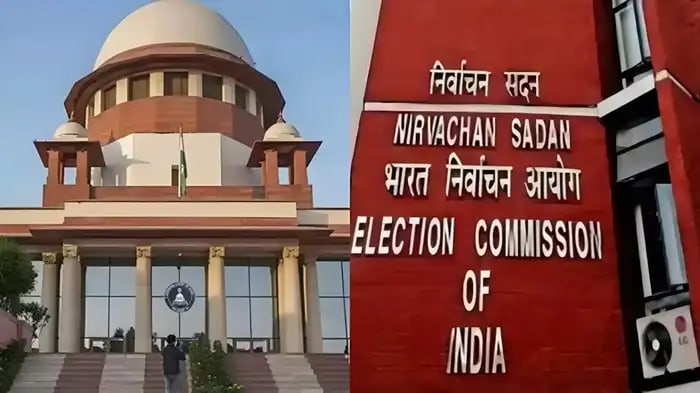
New Delhi: The Election Commission has launched a new campaign to check voter cards in Bihar. Which is being called Special Intensive Revision (SIR). Under this, the work of updating the voter list is also going on. But, now the issue of citizenship verification is also being raised in it. The Election Commission of India usually stays away from citizenship verification. ECI takes care of the claims and objections of the people for adding or removing names in the voter list. The rest of the work is looked after by the Home Ministry.
This decision of the Supreme Court may put a break
Former officials of ECI say that the Supreme Court has also said many times that the job of ECI is to ensure that only citizens get the right to vote. But, the court has also told what things ECI should keep in mind.
The Lal Babu Hussain case of 1995 is an example. In the Lal Babu Hussain vs Electoral Registration Officer (ERO) case, the Supreme Court had canceled two orders of ECI. These orders were issued on 21 August 1992 and 9 September 1994. In the first order, all the District Magistrates were given the right to find out through police investigation whether a person is a foreigner or not. In the second order, ERO was given the right to identify foreign citizens and remove their names from the voter list.
Petitions challenging these orders were filed when notices were issued to about 1.67 lakh people in Greater Bombay (now Mumbai). These documents were sought from them. (i) Birth certificate (ii) Indian passport (iii) Citizenship certificate (iv) Proof of entry in the citizenship register.
A similar case was also reported in Paharganj, Delhi
The same thing happened in Paharganj area of Delhi. Many poor people from Uttar Pradesh and Bihar lived there. ERO did not accept their documents because they were not according to the rules of ECI.
In 1995, the Supreme Court cancelled both the orders of ECI and said that according to the rules of ECI, the responsibility of proving citizenship is on that person, whereas many people had already cast their votes. The court said that this means that ECI had already verified them, only then their names were included in the voter list.
The Supreme Court had raised questions on the way ERO works
The Supreme Court made some rules while raising questions on the way ERO works. The court said that if the ERO feels that the name of a person whose citizenship is doubtful is in the voter list, then before issuing the notice, the ERO should check the previous voter list and keep it in mind.
The Supreme Court said that this investigation should be quasi judicial. The investigating officer should pay attention to all the evidence, whether they are documents or something else and the person should get a chance to present his point and prove his case. The investigating officer should keep in mind the Constitution, Citizenship Act and the principles of Natural Justice.
The problem of illegal immigrants is very high in Assam. This issue arose again during the 'Intensive Revision' in 2002. In the HRA Choudhary vs ECI case, many voters in Nagaon, Assam were put in a separate voter list with 'D' (doubtful citizenship). This was done after the 1997 order of the ECI.
The Supreme Court reiterated the 1995 order
The Supreme Court reiterated the rules given in 1995, accepting the authority of the ECI. The court said that before removing a person from the voter list, he should be given a chance to present his case. Also, the case of doubtful citizenship should be sent to the concerned tribunal/authority and action should be taken accordingly.
The Supreme Court reminded the ECI that its purpose is not to do injustice to the right citizens, but to prevent foreigners from being included in the voter list. After this, the ECI worked carefully and adopted a less intrusive method to update the voter list. The ECI trusted the voters more.
An example is that in 2013, a voter in Goa was found to be a foreign citizen after contesting the election. This matter went to the court and the Home Ministry also had to intervene in it. After this, the ECI changed its Form 6 (application for inclusion of name in the voter list). Now every voter has to declare that he is an Indian citizen and action will be taken against him for giving wrong information.


Discussion (0)
Leave A Reply
Speak Truth To PowerModerated by Times Indian