

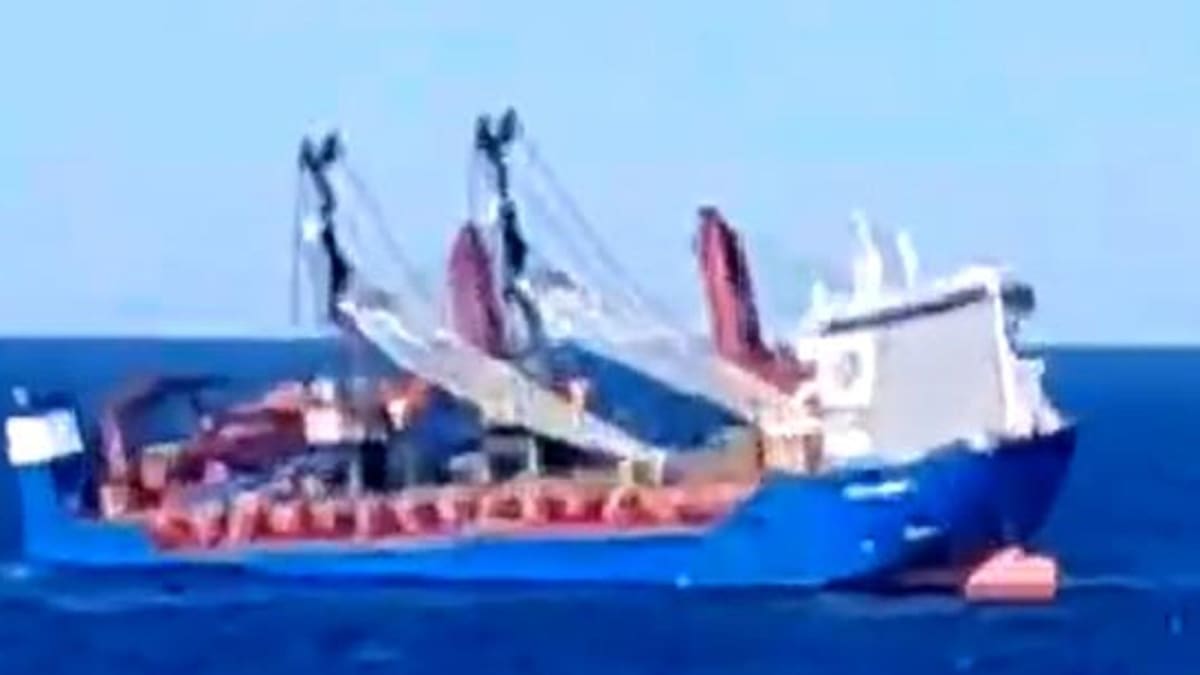
Moscow: The Spanish newspaper La Verdad has reported a mysterious explosion on the Russian ship Ursa Major. The newspaper stated that the Russian ship sank in the Mediterranean Sea, 60 miles south of Cartagena, on December 23, 2024, after an explosion. At the time, it was carrying two VM-4SG nuclear reactor cores from Russia to North Korea. The report claims that the ship sank due to a mysterious underwater explosion, and that deep espionage and conspiracy may be involved. The Spanish maritime investigation report (8059/24-Escora) claims that the ship was carrying two heavy containers that were not listed in the manifest and were covered with blue tarpaulins. According to the investigators, this was not merely an accident, but could be part of a larger conspiracy and espionage operation.
The VM-4SG reactor is used in the nuclear power plants of Project 667BDRM SSBNs, an advanced variant of the Delta-class submarine. It was developed by the Rubin Central Design Bureau and built at Sevmash in Severodvinsk between 1984 and 1992. After completion and testing, it was commissioned in seven Russian submarines. These reactors allow a ship to remain at sea for extended periods, in addition to making the ship's design quite compact and providing a high level of security.
Was there a military conspiracy behind the sinking of the Ursa Major? The report claims that the explosion on the ship was so precise and powerful that it raised suspicions of the use of a supercavitating torpedo. Seismic data points to an explosion equivalent to 20–50 kilograms of TNT. The ship's route was highly suspicious; having departed from St. Petersburg ostensibly bound for Vladivostok, it was following an unusual route of approximately 15,000 kilometers, suggesting a possible destination of Rason port in North Korea.
These Delta-class submarines, powered by two OK-700A nuclear propulsion units, can reach speeds of up to 24 knots underwater and operate at depths of up to 320 meters. With this reactor, their range becomes unlimited, and they can operate continuously for up to 90 days. However, there are some doubts about the La Verdad report. Several Russian analysts suggest that the reactor is not yet in production. The entire incident remains mysterious, and the report has neither been officially denied nor confirmed.
What is the connection between the Russian nuclear reactor and India?
This report is particularly significant for India because bmpd TC has reported that the VM-4SG reactor is part of the propulsion unit of India's Arihant-class SSBN submarines. Since the Arihant-class submarines are still under construction, it is likely that the VM-4SG reactors are also being manufactured. According to the defense analyst platform bmpd, the VM-4SG reactor design is used in the CLWR-B1 reactors installed in India's Arihant-class SSBN submarines. Officially, India claims these are indigenously built, but it is also believed that several key components, particularly the reactor vessel (hull), were manufactured in Russia. In 2021, L&T and NPCIL announced the completion of a reactor hull manufacturing facility in Hazira, Gujarat, but no information about the production of any hulls has been publicly released so far. This raises the question: Is India still strategically dependent on Russia?
La Verdad cited information from the Spanish maritime investigation (Report 8059/24-Escora) into the sinking of the Russian cargo ship. Retired Indian Air Force fighter jet pilot Vijendra K. Thakur, who is also a software architect and military analyst, wrote in a report for the Eurasian Times that "logically, it follows that the ship was sunk by a US/NATO submarine to prevent North Korea from acquiring SSN/SSBN capabilities." However, this has not been confirmed.
What impact would the sinking of a nuclear submarine have on India?
The reassuring aspect of this entire incident is that all of India's Arihant-class submarines have been built, and the fourth submarine is undergoing sea trials. Therefore, even if the Ursa Major did indeed carry VM-4SG reactors, it would not have an immediate impact on India's existing naval nuclear capabilities. However, questions arise regarding North Korea's progress in developing nuclear-powered submarines (SSN/SSBN capabilities). In January 2021, Kim Jong Un announced at the 8th Congress of the Workers' Party of Korea that the design of a new nuclear-powered submarine, part of a five-year weapons development plan, was in its final stages.




Discussion (0)
Leave A Reply
Speak Truth To PowerModerated by Times Indian