

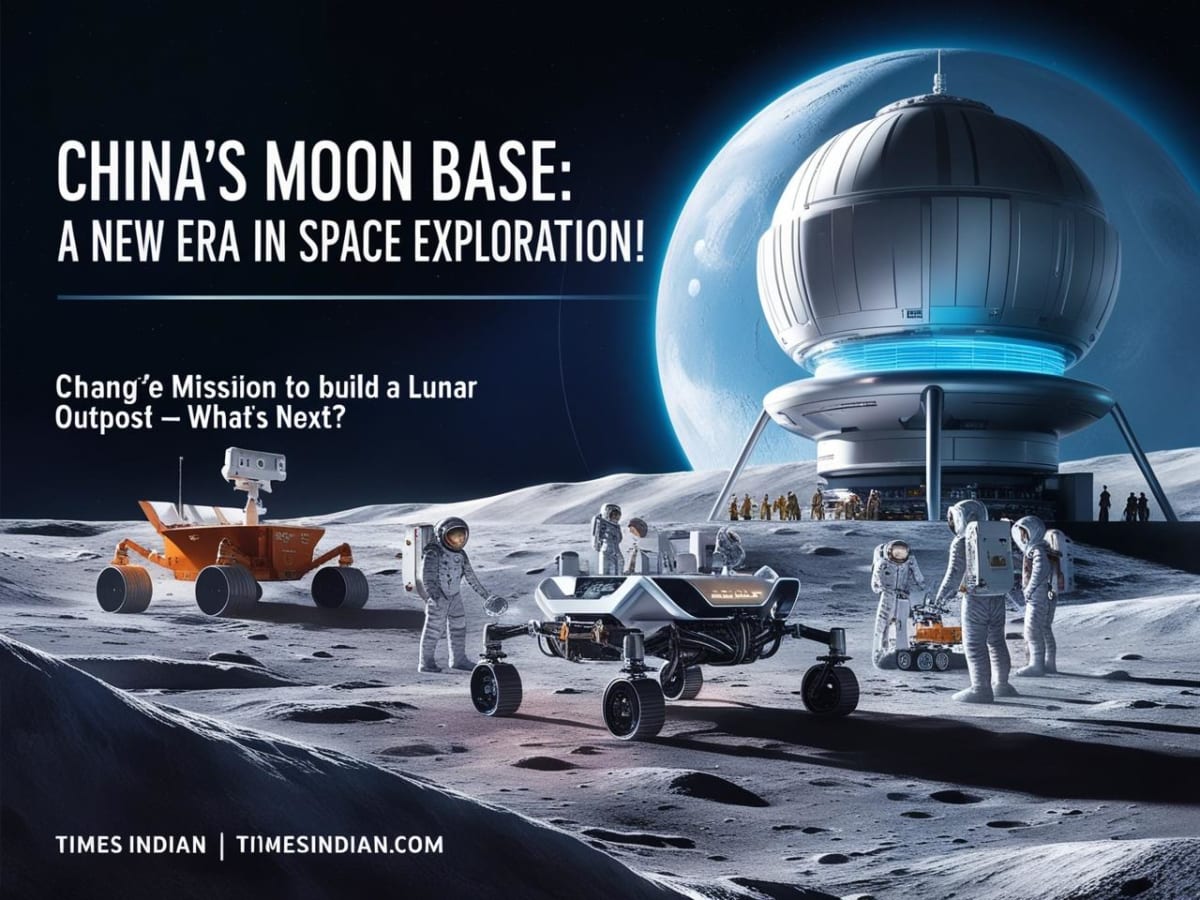
Beijing: China seems ahead of the US in the AI race and is now making a big plan for the moon. China is planning to send a flying robot to the far side of the moon next year. It will search for frozen water on the moon. If China succeeds in this, it could be important for future exploration on the moon. This flying 'flying detector' will be sent to the south pole of the moon as part of the Chang'e-7 mission. This mission aims to bring China closer to landing astronauts on the moon in the next five years.
China is trying to become a major player in space along with other countries including the US. From a scientific point of view, it is not only beneficial for China, but it is also important for resources and national security. However, finding water on the moon is not a new thing. Last year, under the Chang'e-5 mission, Chinese scientists discovered water in the moon's soil. Earlier, the US space agency NASA and Indian spacecraft have also claimed the presence of water on the moon.
China’s Secret Moon Base Project—What It Means for the Future of Space?
However, scientists believe that there is ice in the craters on the far surface of the moon, which can become a source of water in future missions. China is preparing to build a base on the moon's south pole. According to Chinese space experts, there is a possibility of water in the deep craters present there. According to a CNN report, Wu Weiren, designer of China's Lunar Exploration Project, said that this flying detector will investigate one or two craters on-site. Detecting ice will not only reduce the cost of space missions but can also help in maintaining human life on the moon.
Will China send humans to the moon?
Many experts say that the use of water present on the moon depends on many factors, such as the quantity of water and its chemical composition. China's National Space Administration has carried out several moon missions one after the other in recent years. Last year also, China reached the far side of the moon. Through this mission, China became the first country to bring back samples from the far side of the moon. China now aims to send humans to the moon by 2030. Before that, the Chang'e-7 mission will be sent in 2026, which will conduct the most detailed survey of the South Pole. It will include a lander, rover, and flying detector.





Discussion (0)
Leave A Reply
Speak Truth To PowerModerated by Times Indian