

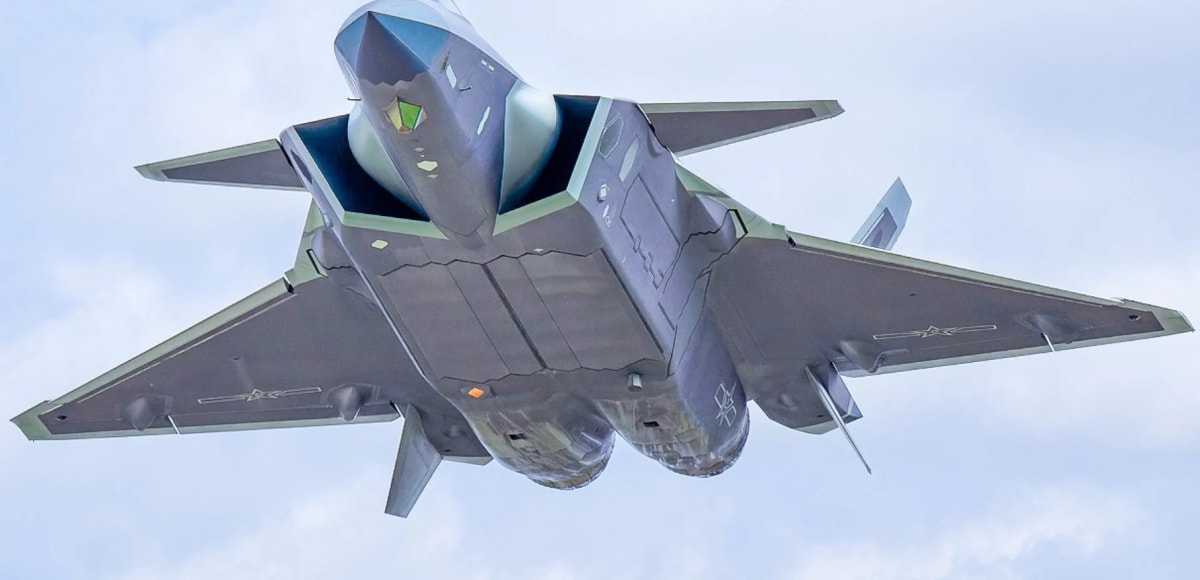
Islamabad/Beijing: After Pakistan's defeat at the hands of India in Operation Sindoor, China is working very fast to strengthen its army. In this connection, there is a report that very soon China is going to hand over the J-35A fighter aircraft, called FC-31 in China, to Pakistan. The process of delivery of fighter aircraft is in the final stage. This agreement between China and Pakistan regarding the fifth generation fighter aircraft is not just a defense agreement, but an attempt to change the balance in the airspace of South Asia. While India has so far maintained a regional edge in the air sector thanks to its fighter jets like Rafale, Su-30MKI and Mirage 2000, the deployment of J-35A will equip Pakistan with a platform that is technologically more advanced than most of India's fighter jets.
The J-35A stealth fighter aircraft has been developed by China's state-owned defense company AVIC. It is originally a fighter aircraft designed for the Navy, but now its Air Force variant has also been developed. It has advanced features like AESA radar, infrared search and track (IRST), network-centric warfare capabilities, data fusion system and supercruise. This fighter jet carries weapons in the internal weapon bay, which maintains its stealth profile. The J-35A is equipped with China's most advanced missiles, especially the PL-15 and PL-17. The range of PL-15 is between 200 to 250 km and that of PL-17 is between 350 to 400 km.
How much threat do Pakistani jets pose to India?
PL-15 and PL-17 missiles can be capable of targeting Indian AEW&C, AWACS and refueling tankers from a long distance, giving Pakistan a first strike aerial advantage for the first time. This capability can change Pakistan's air strategy from a defensive system to an offensive and deep strike strategy. Especially when it is linked to China's satellite network. Therefore, the J-35A fighter aircraft can pose a serious threat to India. The Indian Air Force currently has 31 squadrons, whereas according to the set standards, the army should have 42 squadrons at all costs. India's main fighter jets are mainly fourth-generation aircraft like Rafale, Su-30MKI, Mirage-2000, MiG-29UPG and Tejas Mk1, which can prove to be technically weak in front of a stealth fighter like J-35A.
Although the Rafale fighter aircraft comes quite close to competing with the J-35A, especially when equipped with Meteor missiles and Spectra electronic warfare systems. But the Rafale fighter aircraft does not have stealth capability. In such a situation, the J-35A can become a big threat to it during BVR warfare. Jets like India's Su-30MKI are heavy and excellent in maneuvering, but their radar signature is very high, which can make them vulnerable in BVR warfare against stealth platforms. If Pakistan gets squadron-level deployment of J-35A, it can be capable of challenging India quite seriously. Experts believe that if India has to challenge Pakistan, then it will have to develop stealth fighter jets, more AEW&C platforms and electronic warfare capabilities in its fleet. Otherwise, Pakistan will definitely become a threat to India.
It is important for India to seriously consider modernizing its Air Force. The first step in this direction will be to accelerate its stealth fighter program AMCA and expand the fleet of state-of-the-art fighter aircraft like Rafale. Apart from this, India will have to further strengthen its AEW&C and ground based air defense system to stop the enemy's BVR capability. The S-400 missile system and the indigenous XRSAM project can play an important role in this. Also, India will have to expand its electronic warfare, cyber domain, and satellite real time surveillance capabilities. If India balances all these areas, only then will it be able to respond to the threat of stealth fighters like J-35A.




Discussion (0)
Leave A Reply
Speak Truth To PowerModerated by Times Indian