

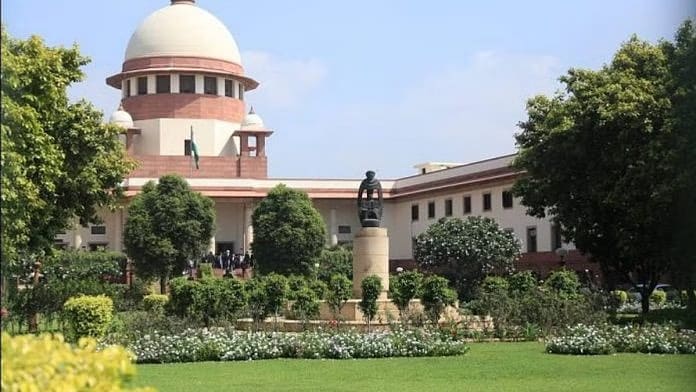
New Delhi: Chief Justice of India (CJI) Sanjiv Khanna on Wednesday said that the judiciary is unique compared to other branches of the state, as it connects directly with the citizens and provides them with an easy opportunity to raise their grievances, even if they are against the state and the law. CJI Khanna said this at the "Celebration of 75 Years of the Indian Constitution" event organized by the Supreme Court Advocates-on-Record Association (SCAORA). Justice Gavai said that through judicial review, the Indian judiciary has interpreted the Constitution, declared unconstitutional laws invalid and upheld democratic values.
What makes the judiciary unique?
The Chief Justice said that when I think about what makes the judiciary unique, I understand two main things. The legislature is elected by the people and they represent the people. The executive, especially the political executive, is answerable to the Parliament or the legislature. But the specialty of the judiciary is that it is directly connected to the citizens and it is the easiest medium to hear their grievances. Anyone can go to the court of any level of the judiciary, hire a lawyer, or present his case himself. This means that we are directly connected to the citizens. Apart from the Chief Justice, Justices B. R. Gavai, Surya Kant and Abhay S. Oka also addressed the gathering on this occasion.
'The scope of Article 21 of the Constitution has been broadened'
Supreme Court Justice B. R. Gavai said that the scope of Article 21 of the Constitution has been broadened and it has been developed to encompass various rights so that the essence of the "right to life" can be fully realized. Justice Gavai said that every day hundreds of citizens come to the court seeking justice, which is a testimony to their unwavering faith in this institution. The Supreme Court has interpreted Article 21 to include many important rights, such as the right to live with human dignity, right to shelter, right to health, right to sleep, right to protest, right to clean air and water, right against noise pollution, right against illegal and unreasonable detention, right to judicial protection, rights of arrested persons, right to food, right to privacy and right to protection from the adverse effects of climate change.
Justice Gavai said that the judiciary is not just an institution of dispensing justice, but it plays a fundamental role in maintaining the rule of law, protecting rights and ensuring justice for all. He said that "This trust is a responsibility, which the judiciary discharges with utmost devotion, reinforcing the principles of fairness, justice and equity enshrined in the Constitution. Over the last 75 years, the Supreme Court has played a leading role in shaping the mandate of the Constitution.
'The Indian Judiciary Has Interpreted the Constitution'
Justice Gavai said that through judicial review, the Indian judiciary has interpreted the Constitution, declared unconstitutional laws invalid and upheld democratic values. He said that in the Kesavananda Bharati case (1973), the largest ever 13-judge constitutional bench of the Supreme Court ruled that the basic structure of the Constitution cannot be abolished by any amendment. Under this, it was said that the fundamental features such as the supremacy of the Constitution, democratic government, secularism, separation of powers between legislature-executive-judiciary and federal structure. In the case of Maneka Gandhi vs Union of India, the Supreme Court ruled that the basic structure of the Constitution cannot be abolished by any law. The prescribed procedure must be fair, just and reasonable.
On this occasion, Supreme Court judge Abhay S. Oka expressed concern over the increasing number of pending cases, particularly mentioning the over 4.50 crore pending cases in district courts. Given the gravity of the pending cases, it would not be entirely correct to say that the common man has unwavering faith in the judiciary.


Discussion (0)
Leave A Reply
Speak Truth To PowerModerated by Times Indian