

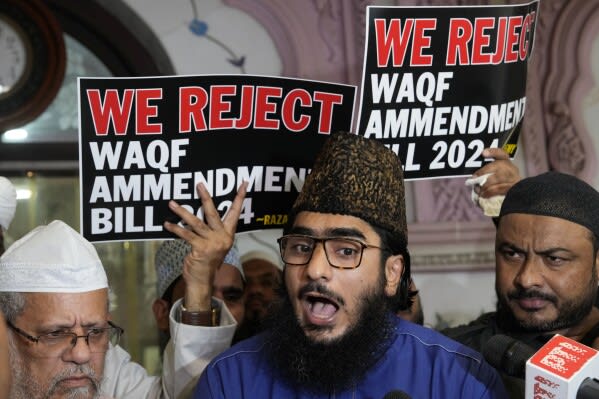
New Delhi: A bench headed by Supreme Court Chief Justice (CJI) Sanjeev Khanna has sought a reply from the Central Government on the issue of 'Waqf by User' within 7 days. The Supreme Court has not put any ban on the Waqf law at present. The Supreme Court has said that it is not possible to read 110 to 120 files. Only five points have to be decided, on which the hearing will take place. Petitioners should reach a consensus on the main points. During the hearing, Solicitor General Tushar Mehta said that the Central Government wants to file a reply within 7 days. He assures the court that no appointments will be made to the Waqf Council and Waqf Board under Sections 9 and 14. There will be no change in Waqf by User nor will any change be made by the Collector till the next date of hearing. We take this statement on record. Let's understand the whole thing.
What does CJI's emphasis on Waqf by User mean?
The CJI said that the writ petitions challenging the Waqf Act of 1995 and the amendments made in 2013 will be shown separately from this list. The petitioners who filed the writ in the 2025 case have the freedom to file a reply as a special case. We will hear only five petitions. The principle of 'Waqf by User' means that a property which becomes a Waqf due to its continued use for religious or charitable purpose such as mosques and graveyards, even if it is not formally declared a Waqf. To do Waqf, now this condition has been added that the person should be a follower of Islam for at least the last five years.
How did the concept of Waqf come, know here
It is believed that the concept of Waqf came to the fore when Caliph Usman saw that due to lack of water in the desert area, a person was selling water near Medina. Due to this, he bought water facility in the name of Allah so that water could be available for camels for free. This Waqf still exists after 1400 years. Most Islamic countries have a Ministry of Auqaf which looks after the functioning of Waqf. Their departments have jurists or religious scholars like Ulema. All of them follow Islamic jurisprudence. This system is different in our country because it is not a Muslim country.
What types of Waqf are there in Islamic countries
Islamic countries have Waqf which are just like our Waqf or Endowment departments. Waqf originated in Bahr-e-Mulla. It was a charity created by Usman ibn Affan, a cousin and companion of Prophet Muhammad. There is a waqf in every Islamic country in the world. However, in those countries it is also known by many other names including Auqaf, Foundation, Endowment. There is a General Directorate of Foundation in Turkey. It manages and audits waqfs according to Islamic law since 1924. It has been working since the time of the Ottoman Empire till today.
What is waqf called in Egypt, Iraq and Syria
Egypt has a Ministry of Auqaf. It is similar to the law of trust. It has a trustee mosque. It manages other properties including land, market and hospital. Auqaf was nationalized during the rule of Muhammad Ali (1805-1848). Similarly, in countries like Sudan, Syria, Jordan, Tunisia and Iraq, waqf departments work under the Ministry of Religious Affairs. In fact, Iraq has Sunni Endowment Office, Shia Endowment Office and Endowment Office of non-Muslim communities.
What is there in Saudi Arabia, Indonesia or Bangladesh
Many other Islamic countries like Saudi Arabia, Oman, United Arab Emirates, Bangladesh, Malaysia, Indonesia have Endowment Department (eg Islamic Religious Endowment, Jerusalem) or Waqf under the Ministry of Religious Affairs. In all these countries, Waqf is known by different names and its nature is not secular.
What are the objections of Indian Muslims and MPs
Congress' Kishanganj MP Mohammad Javed and AIMIM MP Asaduddin Owaisi have also filed a petition in the Supreme Court. Many Muslim organizations and leaders have protested from Parliament to the road regarding the Waqf Bill. Everyone's objections are mainly that many important changes have been made in the new bill related to the structure of the Waqf Board, property rights and judicial process. The government says that these are necessary steps to bring transparency and accountability in Waqf properties. While the opposition parties argue that this bill is an attack on the religious freedom of minorities.
Is the Waqf Amendment Bill a violation of fundamental rights?
MP Mohammad Javed has said in his petition that the basic form of the Waqf Amendment Bill violates the fundamental rights of Muslims. It is against Articles 14, 25 (D) and 26 of the Constitution. Because after its implementation, the interference of the government in the Waqf of Muslims will increase. Muslim organizations have raised serious objections to many provisions of this bill. The government has changed the structure of Waqf Boards and Central Waqf Council. Now non-Muslim members have also been included in it.
What are the rights of the Collector on Waqf, which are objected to?
Right to survey Waqf properties
The Waqf Commissioner has been removed from the post and given to the District Collector. In case of dispute on government-occupied lands, the Collector's order has been considered final. However, it has been said that the Tribunal can go against the Collector's decision, but the decision of the Waqf Tribunal will no longer be considered the final decision. Its decisions can now be challenged in the High Court.
Now let's understand the meaning of Waqf by User
Waqf by User means the property which was in use for religious purposes will no longer be considered a Waqf. This has been removed in the new provision. The principle of 'Waqf by User' means that such property which becomes a Waqf due to continuous use for religious or charitable purpose like mosques and graveyards. Even if it has not been formally declared a Waqf. This condition has been added for Waqf that the person should be a follower of Islam religion for at least the last five years.
Muslims have the most objection to this
The provisions of the bill that Muslims have the most objection to include changes related to the structure of Waqf. Earlier, under the Waqf Act, 1995, only Muslim members could be in the Central Waqf Council and State Waqf Board, which included both elected and nominated members. Now all the members will be appointed by the government and it has been made mandatory to include at least two non-Muslim members in it.
What else is there to worry about about the new bill
Union Minister of Minority Affairs Kiren Rijiju assured in Parliament that this change will not interfere in the religious matters of Muslims. However, now with the new system, non-Muslim members can be in majority in the Waqf Council and State Waqf Board. In the earlier law, it was necessary for all members except the minister to be Muslim. Now, in the new law, 12 out of 22 members of the Central Waqf Council and 7 out of 11 members of the State Waqf Board can be non-Muslim. This is the concern of Muslims the most.
These objections are also about the rights of the collector
In the Waqf Amendment Bill, the right to survey Waqf properties has now been given to the Collector of the district. Earlier this right used to be with the Waqf Commissioner. In case of dispute regarding Waqf properties occupied by the government, now the decision of the Collector will be considered effective. It has been provided in the bill that if any government land has been identified as Waqf, then it will not be considered Waqf. In case of uncertainty, the Collector will decide who owns the property and will submit his report to the state government. Apart from this, now the decision of the Waqf Tribunal will not be considered final. These decisions can be challenged in the High Court. This may take more time to settle the cases.
Pakistan-Bangladesh also scared of the new Waqf Bill
India's two neighbors Pakistan and Bangladesh have also protested against the Waqf Bill. Bangladesh Jamaat-e-Islami, Bangladesh Islami Chhatra Shibir have issued statements condemning the passing of this bill. At the same time, Pakistani media has described it against the Muslim community. Pakistan's newspaper The Dawn wrote in an article that Modi government has passed a new bill targeting the Muslim community.
Waqf owns 9.4 lakh acres of land
Waqf is an Arabic word which means to stay or halt. It is claimed that when a property is Waqfed in the name of Allah, it becomes in the name of Allah forever. Then no change can be made in it. Waqf property cannot be bought or sold nor can it be transferred. Waqf Board currently has about 8.7 lakh properties in the whole of India, which are spread over about 9.4 lakh acres of land. Their total value is estimated to be around 1.2 lakh crore rupees. India has the most Waqf property in the world.




Discussion (0)
Leave A Reply
Speak Truth To PowerModerated by Times Indian