

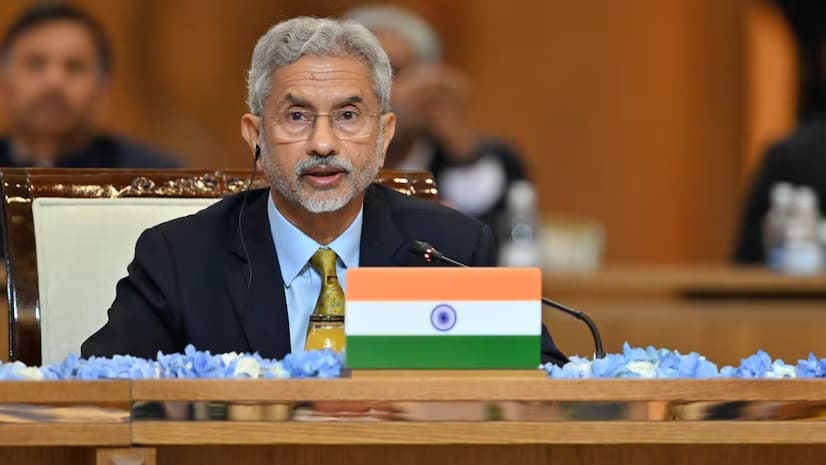
New Delhi: Foreign Minister S Jaishankar has said that if there are terrorists in Pakistan, India will kill them there. He said this about India's retaliatory action after the terrorist attack in Pahalgam last month. India has adopted a new method to deal with terrorism. Under this, if there is a terrorist attack from Pakistan, then India will directly enter Pakistan and kill the terrorists. On May 10, an agreement was reached between India and Pakistan to stop military action. Jaishankar said that this agreement was reached after India's attacks. India's attacks forced the Pakistani army to stop firing at each other. He also said that America had no role in this agreement and neither will America be involved in any talks with Pakistan.
'If terrorists are in Pakistan, we will kill them there'
India launched Operation Sindoor on May 7. This operation was in response to the 'Pahalgam terror attack' on April 22. 25 civilians and a foreigner were killed in that attack. India targeted nine terrorist hideouts in Pakistan-occupied areas. After this, there was heavy fighting on both sides for four days. Both countries used drones, missiles and long-range weapons. Then both sides agreed to stop military action. Jaishankar said in an interview to Dutch public broadcaster NOS that Operation Sindoor is still going on. According to him, 'The operation is continuing because there is a clear message in it that if an attack like April 22 happens, there will be a response, we will kill the terrorists.' He also said, 'If terrorists are in Pakistan, we will kill them there. Therefore, there is a message to continue the operation, but continuing the operation does not mean firing at each other. Right now, there is a consensus on fighting and military action.'
Asim Munir hints at religious extremism
When asked if the operation was passive, he replied, 'You can say whatever you want, but I can tell you that the message is clear and the message is take action.' Jaishankar said the fighting started because of a 'barbaric terrorist attack' in Jammu and Kashmir. In that attack, 26 people were 'killed after reaffirming their faith in front of their families.' He said the aim of the attack was to harm tourism, which is the mainstay of Kashmir's economy, and to 'create religious animosity'. The foreign minister said, 'Intentionally, an element of religion was introduced and to understand this you have to see that you have a Pakistani leadership, especially the army chief, who are very driven by a radical religious viewpoint. Obviously there is some connection between the views expressed and the behaviour carried out.' He said this in the context of Pakistan Army Chief Asim Munir's remarks about the two-nation theory made a week before the Pahalgam attack.
May 10 was 'decisive day': S Jaishankar
Jaishankar said it was "impossible" for the Indian government not to respond to the Pahalgam attack, carried out by The Resistance Front (TRF), a front for Pakistan-based Lashkar-e-Taiba (LeT). "It was imperative that we respond because the lack of response... was impossible in such a situation... Our government is very clear that if such an attack takes place, there will be a response," he said. Jaishankar said India initially targeted nine locations listed by the United Nations as terror hubs. He said that was when the Pakistani army "decided to fire at us". He said the "decisive day" was May 10, when India made eight Pakistani airbases inoperable by attacking them and targeting runways and command centres. "I think this forced the Pakistani army to accept that we need to stop firing at each other," he said. What has happened now is that, at the moment, there is no firing...'
'If the Pakistanis want to stop fighting, let us know'
Jaishankar, responding to a number of questions about the role of the US, particularly on President Donald Trump's claims of brokering a ceasefire between India and Pakistan, said the agreement reached on May 10 was bilateral. Jaishankar said US Secretary of State Marco Rubio spoke to him while Vice President JD Vance called Prime Minister Narendra Modi. Leaders from West Asia and other regions also reached out with the aim of easing tensions. "When two countries are engaged in conflict, it is natural that countries of the world call and... try to express their concern... but the cessation of firing and military action was something that was negotiated directly between India and Pakistan," he said. He further said, "We made one thing very clear to everybody who spoke to us, not just the US but everybody, saying that if the Pakistanis want to stop fighting, they need to tell us. We need to hear it from them. Their general has to call our general and say this; and that is what happened.'
Talk with Pakistan only on terrorism and return of PoK
Jaishankar said that India is not talking to Pakistan on any issue The EU is willing to discuss with the US only on the elimination of terrorism and the return of the part of Kashmir illegally occupied by the neighbouring country. He said the borders in Kashmir are not up for negotiation, "because Kashmir is part of India." Responding to a question about border conflicts with China and Pakistan holding India back economically, Jaishankar said, "Our security challenges were far more dangerous than yours [Europe's], so we had to prioritise security. You don't choose between security and economic prosperity. Today, you are realising they are two sides of the same coin."


Discussion (0)
Leave A Reply
Speak Truth To PowerModerated by Times Indian