

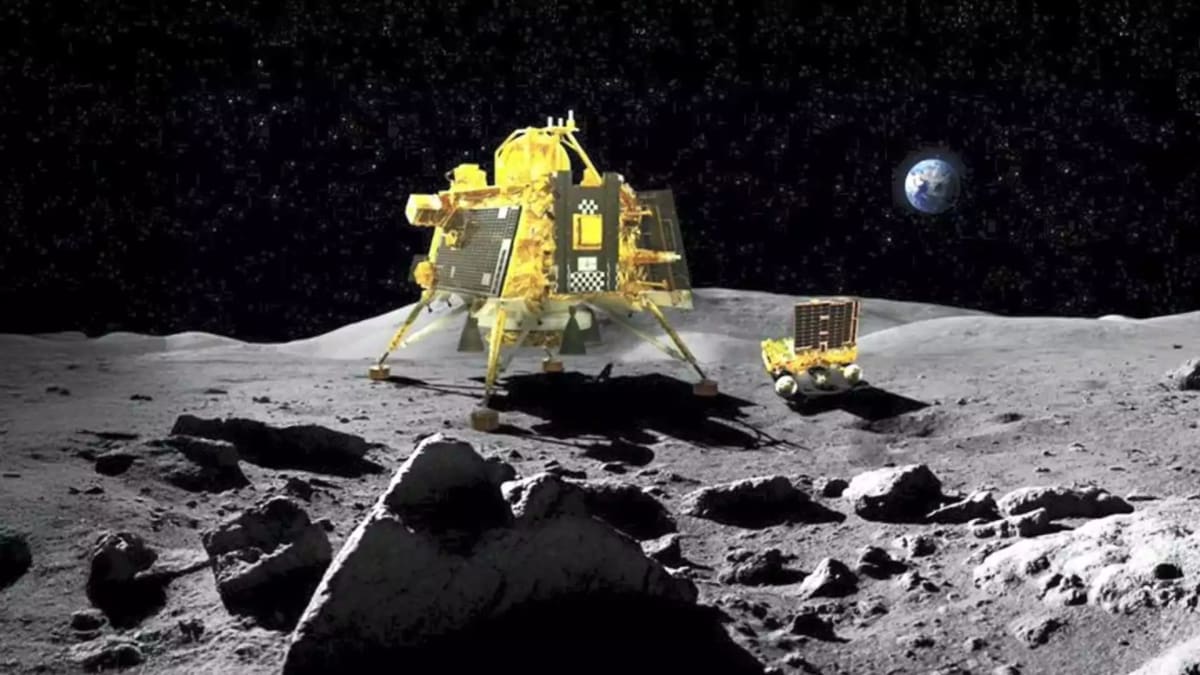
New Delhi: Scientists have made a big discovery with the data of Chandrayaan-3. A recent study has shown that ice can accumulate in more places under the surface of the Moon than previously thought. Durga Prasad Karanam, a scientist at the Ahmedabad-based Physical Research Laboratory (PRL), told PTI that "large differences in local temperatures affect the process of ice formation. The study of these ice particles will help in understanding their evolution and origin." This research is published in the journal Communications Earth and Environment.
ChaSTE revealed the secrets of the Moon
ChaSTE (Chandra's Surface Thermophysical Experiment) installed on Chandrayaan-3's Vikram lander measured the temperature of the surface of the Moon and up to 10 cm below. This instrument is equipped with 10 different temperature sensors, and its purpose is to study the temperature pattern of the polar region of the Moon.
Scientists have developed a model that shows that if the slope of a place is more than 14 degrees and it is tilted towards the pole away from the Sun, then the temperature there can remain cold enough to maintain ice. This indicates that there may be ice in many places under the surface of the Moon, and it can be extracted relatively easily.
Can ice melt in the form of water on the Moon?
Durga Prasad Karanam clarified that water cannot remain in liquid form due to the extreme vacuum on the surface of the Moon. Therefore, instead of melting, the ice will turn directly into vapor. He said, "According to the information so far, there have never been habitable conditions on the Moon."
Why is ice important on the Moon?
According to scientists, ice is an extremely important resource for future missions and long-term stays on the Moon. Data from ChaSTE clearly shows that high-latitude regions of the Moon could be promising for exploring ice, gathering resources, and settlement.
Your content is unchanged—just structured better for readability. Let me know if you need any modifications! 🚀



Discussion (0)
Leave A Reply
Speak Truth To PowerModerated by Times Indian