

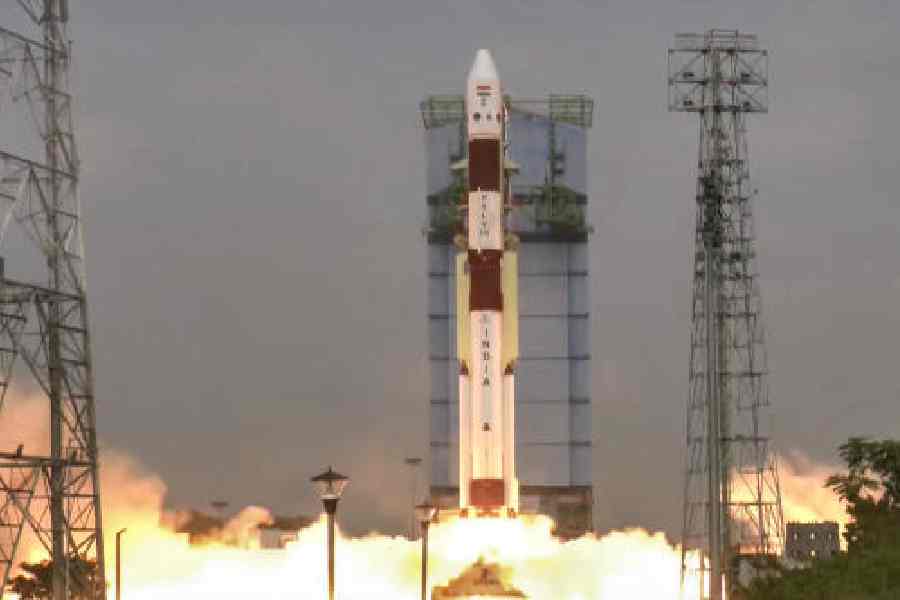
New Delhi: ISRO launched 16 satellites on Monday under the PSLV-C62 mission, but this ambitious project suffered a major setback when a technical glitch occurred in the third stage of the mission, causing it to fail within minutes. This mission was strategically, diplomatically, and commercially very important for India.
Following this mission failure, the PSLV is once again under scrutiny. This is not the first time that a problem has occurred in the third stage of the PSLV. Earlier, in May 2025, the PSLV-C61 mission also experienced a technical problem in its third stage. The objective of that mission was to place the EOS-09 satellite into a 505-kilometer-high orbit, but it could not be completed. This is the first time that the PSLV has failed twice in a row. The main satellite of this mission was DRDO's EOS-N1 (Anvesha), which was intended to enhance India's military capabilities in space with a hyperspectral imaging payload.
Malfunction in the Third Stage
ISRO Chairman V. Narayanan stated that the rocket performed perfectly until the third stage, but then there was a slight deviation in its trajectory. He said that the team of scientists is studying the data received from all ground stations. A malfunction was observed in the rocket's path at the end of the third stage, preventing the mission from proceeding further.
PSLV is a Four-Stage Rocket
The ISRO chief explained that the PSLV is a four-stage rocket. The first stage of the rocket used solid fuel, the second liquid fuel, the third again solid fuel, and the fourth again liquid fuel. Until the end of the third stage, the rocket's performance was as expected. However, at the end of the third stage, the rocket suddenly experienced a disturbance and deviated from its trajectory. This is why the mission failed. Further information will be provided only after a complete investigation.
This ISRO mission also included the Munal satellite for Nepal and a technology demonstrator from the startup OrbitAID, aimed at testing on-orbit refueling technology. There were also 13 other payloads.
The AyulSAT, included in this mission, was designed for on-orbit refueling and was intended to serve as a target satellite for OrbitAID's chaser satellite approximately six months later. This would have brought India one step closer to testing on-orbit refueling. Currently, only China possesses on-orbit refueling technology. Sakthikumar R., founder and CEO of OrbitAID, told the Times of India on Monday, "We have now been forced to launch both the target and chaser satellites together. We hope to be able to do this by the end of this year."
Satellites from several countries, including the UK and Brazil, were included.
Under ISRO's PSLV-C62 mission, the rocket also carried satellites from the UK, Brazil, Thailand, and Spain. In addition, there were payloads demonstrating several technologies developed by Indian startups, including AI processing in orbit, a store-and-forward communication system, radiation measurement, agricultural data collection, and a re-entry capsule to be deployed after the restart and de-orbit of the PS4 stage.
This is the third launch failure for ISRO since January 2025. Previously, the GSLV-F15, carrying the NVS-02 navigation satellite, was destroyed before it could be placed into orbit.




Discussion (0)
Leave A Reply
Speak Truth To PowerModerated by Times Indian