

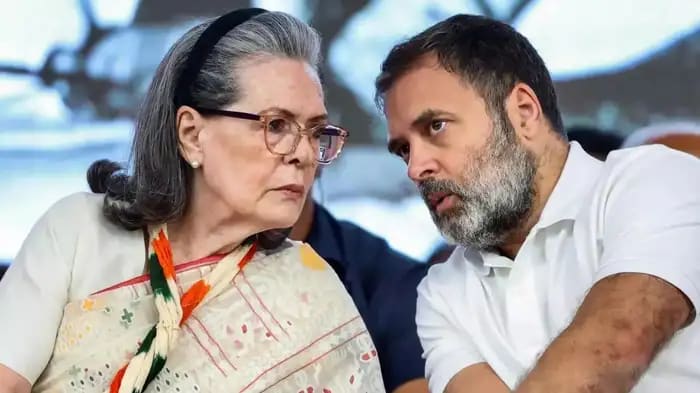
New Delhi: The Enforcement Directorate team has filed a chargesheet against two veteran Congress leaders in the National Herald case. ED has filed a chargesheet against Leader of Opposition in Lok Sabha Rahul Gandhi, Rajya Sabha MP Sonia Gandhi and Overseas Congress President Sam Pitroda. There will be a hearing in this case on 25 April. As soon as this issue came to the fore, the political temperature started rising. Congress has accused the central government of doing this under the spirit of revenge. Not only this, a demonstration has also been announced at ED offices across the country on Wednesday. The way the battle over the whole matter is intensifying, the question is arising in everyone's mind that what is the National Herald case, know the whole matter.
What is the National Herald case?
This case is related to the National Herald newspaper. It was founded in 1938 by India's first Prime Minister Jawaharlal Nehru. The newspaper was owned by Associated Journal Limited (AJL) which published two more newspapers. These newspapers were Navjivan in Hindi and Qaumi Awaz in Urdu. In 1956, AJL was established as a non-profit company and was exempted from tax under Section 25 of the Companies Act. The company gradually went into losses. The company also incurred a debt of 90 crores. Meanwhile, it had to be closed after the financial crisis in 2008, from where this dispute started.
New company formed after AJL
In 2010, another company named Young Indian was formed. 76 percent of its shares were owned by Sonia Gandhi and Rahul Gandhi (38-38 percent) and the remaining shares were owned by Motilal Bora and Oscar Fernandes. The Congress Party transferred its loan of 90 crores to the new company Young Indian. Completely unable to repay the loan, The Associate Journal transferred all the shares to Young Indian. In return, Young Indian gave only Rs 50 lakh to The Associate Journal. Regarding this, BJP leader Subramanian Swamy filed a petition alleging that Young Indian Private had found a way to recover Rs 90 crore in just Rs 50 lakh, which is against the rules.
How the whole case started
Subramanian Swamy filed a case in November 2012. BJP leader Subramanian Swamy had said in his petition that 'Young Indian Private Limited' had found a way to recover Rs 90 crore in just Rs 50 lakh, which is 'against the rules'. Two years after the case was filed, in June 2014, the court issued summons against Sonia Gandhi and Rahul Gandhi. In August this year, the Enforcement Directorate (ED) took cognizance and registered a case of money laundering.
Subramanian Swamy raised the issue
After the case was registered on the petition of Subramanian Swamy, on 19 December 2015, the next year, Congress President Sonia Gandhi and Rahul Gandhi along with other accused were granted regular bail by the Patiala Court of Delhi. The next year in 2016, the Supreme Court refused to cancel the action against the Congress leaders. The matter of relief was that the court exempted all the accused from personal appearance. Two years after this decision, in 2018, the Delhi High Court rejected the petition filed by Sonia and Rahul Gandhi against the notice of the Income Tax Department.
Now the ED has filed a chargesheet
The Congress knocked the door of the Supreme Court against the decision of the High Court. The Supreme Court rejected the petition challenging the decision of the High Court and said that the Income Tax investigation will continue. Now in this National Herald case, the troubles of the Gandhi family have increased further. The Enforcement Directorate has filed a chargesheet against the Leader of Opposition in Lok Sabha Rahul Gandhi, Rajya Sabha MP Sonia Gandhi in this case.
Names of these Congress leaders also in the chargesheet
According to sources, apart from Congress Overseas Chief Sam Pitroda, names of Suman Dubey and other leaders are also included in the ED chargesheet filed in the money laundering case in Delhi's Rouse Avenue Court. The court has fixed April 25 as the date for debate on cognizance in the case. Earlier, ED had started the process of taking possession of the properties related to this case.


Discussion (0)
Leave A Reply
Speak Truth To PowerModerated by Times Indian