

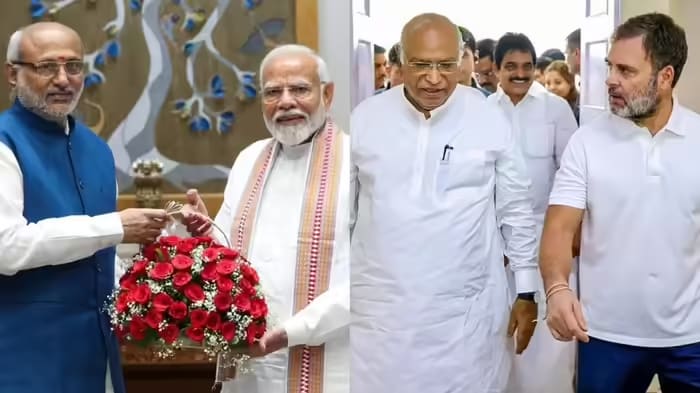
New Delhi: The Bharatiya Janata Party (BJP) on Sunday declared Maharashtra Governor CP Radhakrishnan as the National Democratic Alliance (NDA) candidate for the upcoming Vice Presidential election to be held on September 9. BJP National President and Union Minister JP Nadda, while announcing this, said that we will also talk to the opposition. We should also get their support so that we can together ensure an unopposed election for the post of Vice President. During this, PM Modi and Union Home Minister Amit Shah have also congratulated him. At the same time, CP Radhakrishnan also thanked both the leaders. So, amidst all this, let us tell you who has the upper hand in this election...
NDA or India? Who has the upper hand in the Vice Presidential election
Let us tell you that the election of the Vice President of India is going to be held on September 9. Whose election is done by the members of both Lok Sabha and Rajya Sabha, including nominated members of the Upper House. Currently, the NDA has an upper hand numerically. The combined capacity of both the houses is 786, which includes 6 vacancies - 1 in Lok Sabha (Basirhat, West Bengal) and 5 from Rajya Sabha, including four from Jammu and Kashmir and one from Punjab, where AAP MP Sanjeev Arora resigned after winning the state assembly by-election.
Understand the whole math
At the same time, assuming full participation, a candidate needs at least 394 votes to win. The position of NDA is good at the moment, as there are currently 542 members in the Lok Sabha, of which 293 MPs are from NDA and in the 240-member Rajya Sabha (effective number), 129 MPs are from NDA. Which also includes the support of nominated members.
This gives the ruling coalition an estimated total of 422 votes, far more than the required majority. Under Article 68(2) of the Constitution, an election must be held "as soon as may be" to fill a vacancy in the office of vice-president caused by resignation, death, removal from office or any other cause. The person elected serves a full term of five years from the date on which he enters office.



Discussion (0)
Leave A Reply
Speak Truth To PowerModerated by Times Indian