

The terrorist attack in Pahalgam on April 22 has shaken the whole country. There is a lot of anger about this incident in the whole country. In response to this cowardly act, the Indian government has taken many tough decisions on Wednesday. In which instructions have been given to stop the Indus Water Treaty with Pakistan, close the Attari border post and Pakistani military advisors to leave India.
After these tough decisions taken by India, Pakistan held a meeting of the National Security Council on Thursday. In which Pakistan has described India's decision to stop the Indus Water Treaty as an act of war. Along with this, Pakistan has also talked about suspending bilateral agreements including the Shimla Agreement. Due to the ongoing tension between the two countries after the Pahalgam attack, the Shimla Agreement is once again in the news.
What is the Shimla Agreement
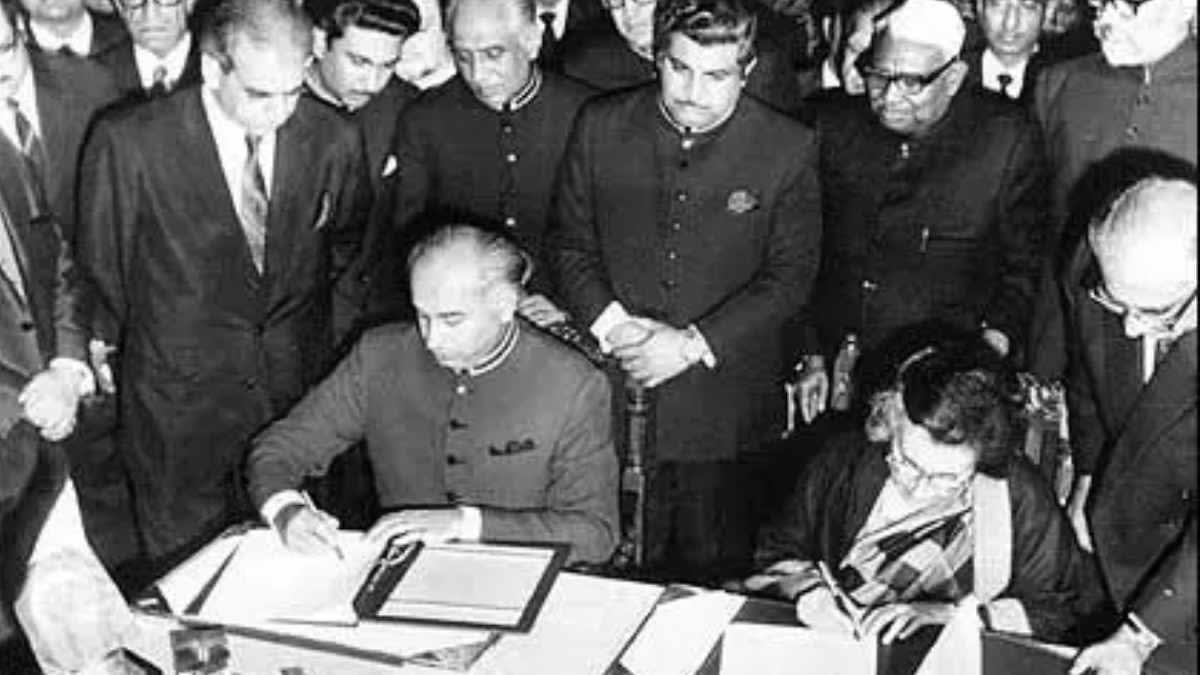
After the Indo-Pak war in 1971, more than 90 thousand of their soldiers were made prisoners of war. After this, efforts began to improve relations between India and Pakistan, and to release Pakistani prisoners of war. Then an agreement was signed in Shimla on 2 July 1972 for better relations between the two countries.
Important points of the agreement.....
- Both countries recognized 17 September 1971 as a ceasefire. It was decided that within 20 days of this agreement, the armies of both countries would go to their respective borders.
- It was also decided that the heads of both countries / governments would continue to meet in the future as well. Officials of both countries would continue to talk to maintain normal relations.
- Both countries will hold direct talks for a peaceful solution to all disputes and problems. There will be no mediation by a third party.
- Transport facilities will be established. So that the people of both countries can come and go easily.
- Trade and economic cooperation will be re-established as far as possible.
- If a final settlement of a problem between the two countries is not reached and the matter remains pending, neither side will make any unilateral attempt to change the situation.
- The two sides will not aid, encourage or cooperate in acts that are detrimental to the maintenance of peaceful and cordial relations.
- The two countries will respect each other's territorial integrity and sovereignty. They will not interfere in each other's internal affairs on the basis of equality and mutual benefit.
- The two governments will take all possible steps within their powers to prevent violent propaganda that targets either of the two countries. Both countries will encourage the sharing of such information among themselves.
- For communication, postal, telegraph services, sea, surface means of communication including border post, air links including flights will be restored.
- Representatives of both sides will continue to meet and discuss among themselves to work on the establishment of peace, the question of exchange of prisoners of war and urban prisoners, the final settlement of Jammu and Kashmir and the possibilities of normalizing diplomatic relations.
- It was agreed between the two countries that trade and cooperation will increase as far as possible in economic and other agreed areas.
- It was agreed to promote exchange in the field of science and culture.
Where was the agreement reached on the Shimla Agreement
On July 2, 1972, both the countries agreed on the agreement in a meeting held at Barnes Court in Shimla, the capital of Himachal Pradesh. This agreement was signed by the then Prime Minister of India Indira Gandhi and the then President of Pakistan Zulfikar Ali Bhutto. That is why it is called the Shimla Agreement. Barnes Court is currently the Raj Bhavan. Even today, the signs of the Shimla Agreement are present in the Raj Bhavan. In this agreement, both the countries had expressed their commitment to resolve their differences through peaceful means and dialogue.
When did Pakistan violate the Shimla Agreement
In the Shimla Agreement of 1972, both countries agreed to resolve the problems through dialogue, but Pakistan violated the Shimla Agreement in 1999, when Pakistani soldiers entered the Indian territory of Jammu and Kashmir. After this, India started an operation to drive out Pakistani soldiers, it is known as the Kargil War.
Effect of Shimla Agreement and its limitations
The Shimla Agreement was an important initiative in itself, which aimed to establish permanent peace between India and Pakistan. Despite this, the relations between the two countries kept deteriorating over time. The conflict over the Siachen Glacier in the 1980s, the Kargil War of 1999, and the ongoing tension over Kashmir are major examples of this decline. In the year 1984, India established control over the Siachen region under "Operation Meghdoot", which Pakistan considered a violation of the Shimla Agreement, because the border line of that area was not clearly marked in the agreement.


Discussion (0)
Leave A Reply
Speak Truth To PowerModerated by Times Indian