

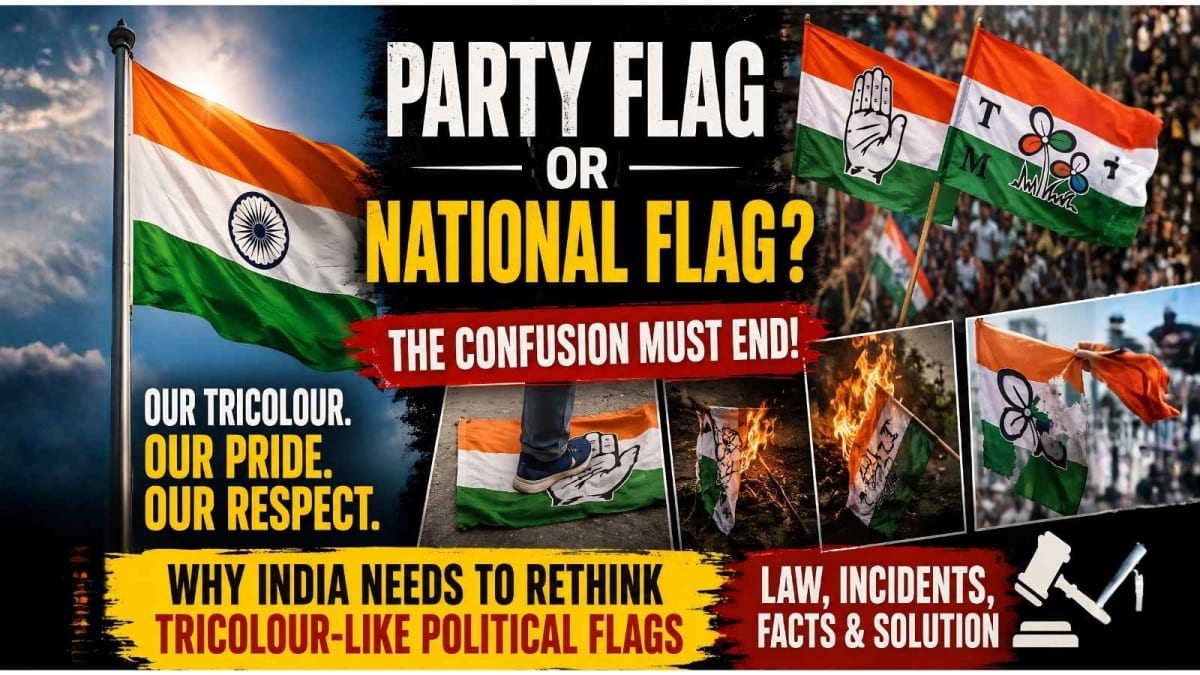
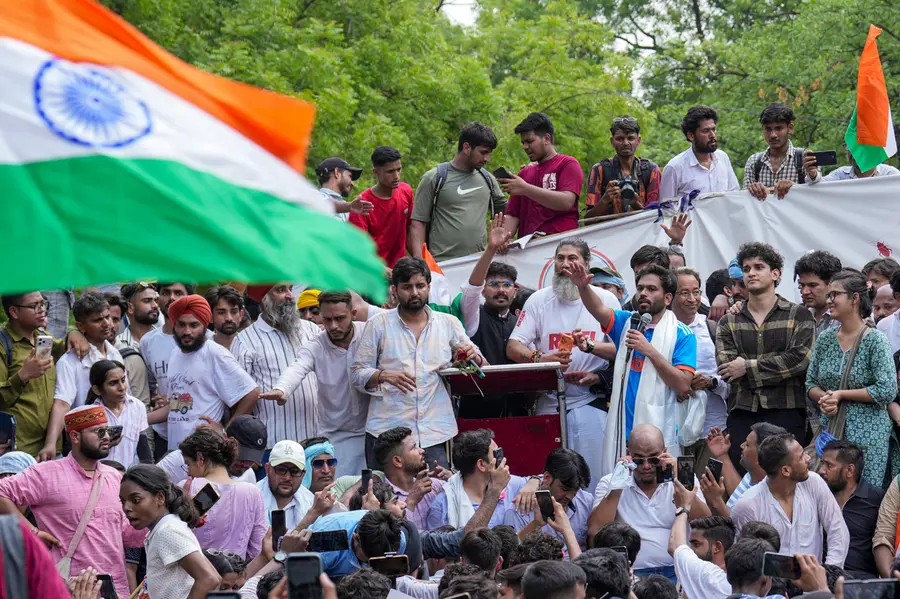
India’s national flag is not just a piece of cloth. It is the pride of 145 crore Indians, a symbol of sacrifice, unity, freedom and constitutional identity. The saffron, white and green colours, along with the Ashoka Chakra, carry deep national meaning. But in India’s political space, a sensitive question has repeatedly come up: should political parties be allowed to use flags that closely resemble the national Tricolour?
This debate is not new. Political party flags such as those of the Congress, Trinamool Congress and some others have often been compared with the Indian national flag because of their colour pattern. The main difference is usually the party symbol in the middle instead of the Ashoka Chakra. For party workers, it may be a political identity. But for ordinary people, especially from a distance, during rallies, protests or election violence, the difference may not be immediately clear.
That confusion becomes serious when party flags are torn, burnt, trampled, kicked, dragged on roads or vandalised during political clashes. Even if the object is technically a party flag, the visual similarity with the national flag can create a feeling that the Tricolour itself is being disrespected.
Why This Issue Matters
In a country like India, political rallies and protests are common. Party flags are carried on roads, tied to vehicles, placed on stages and sometimes used aggressively during heated political moments. When these flags carry the same broad colour identity as the national flag, the line between political symbolism and national symbolism becomes blurred.
A person watching from a distance may not know whether it is a party flag or the Indian flag. A foreigner watching a viral video online may not understand the difference at all. If such a flag is seen being burnt or crushed, it can damage India’s image and create unnecessary outrage, even when the national flag was not actually involved.
This is exactly why many people feel political parties should voluntarily move away from tricolour-like designs. The national flag must remain above party politics.
The Legal Position: What Indian Law Says
India already has strong laws to protect the national flag. Under The Prevention of Insults to National Honour Act, 1971, anyone who burns, mutilates, defaces, destroys, tramples upon or otherwise shows disrespect to the Indian National Flag in a public place can face imprisonment of up to three years, or fine, or both. The law also says that “Indian National Flag” includes visible representations such as pictures, paintings, drawings or photographs of the flag or any part of it.
The Flag Code of India, 2002 also lays down rules for the proper display of the national flag. It allows citizens, organisations and institutions to display the Tricolour, but only with respect and dignity. The flag cannot be used casually, as decoration, or in a damaged or dishevelled condition.
However, the legal challenge is different when the flag is not officially the Indian national flag but a party flag that looks similar. This grey area is at the heart of the debate.
Supreme Court and the Tricolour-Like Party Flag Debate
This question has reached the Supreme Court more than once. In February 2014, the Supreme Court issued notices to the Congress, NCP and Trinamool Congress on a PIL that sought to stop political parties from using flags resembling the Indian National Tricolour. The petition argued that Congress used a colourable imitation of the national flag with a hand symbol instead of the Ashoka Chakra, while NCP and TMC used their own symbols in place of the Chakra.
In July 2025, another PIL was filed against the use of tricolour-like flags by political parties. The Supreme Court refused to entertain the plea, noting that some political parties had been using such flags even before Independence. The court eventually declined to pass any order.
Legally, this means there is currently no clear blanket ban on political parties using tricolour-inspired flags. But the moral and national question remains open: should parties continue using colours that ordinary citizens associate with the national flag?
Recent Incidents Show Why Confusion Is Dangerous
In Kerala, after the 2026 Assembly election results, videos of green flags during Congress-led UDF victory celebrations went viral with false claims that Pakistan flags were waved. Fact-checks later clarified that the flags belonged to the Indian Union Muslim League, a UDF ally, and not Pakistan. The incident shows how quickly political flags can be misread in a charged atmosphere.
In West Bengal, post-poll violence in May 2026 saw TMC offices vandalised in several places, including Kolkata’s Tollygunge and Kasba, Baruipur, Kamarhati, Baranagar, Howrah and Baharampur. Reports said mobs vandalised offices and even kicked broken hoardings. In such political violence, party flags and symbols often become targets, which again raises the concern that tricolour-like party material can be visually confused with national symbols.
There have also been direct incidents of actual national flag disrespect. In July 2025, Bhopal police launched a probe after a viral video showed several Indian flags being burnt at a garbage dump near a ward office. Complaints were submitted by leaders from both Congress and BJP, and police said CCTV footage was being examined.
Outside India too, the Tricolour has been targeted. In April 2018, during protests in London, the Indian flag was torn down, cut and burnt near Parliament Square during Prime Minister Narendra Modi’s UK visit. India pressed for legal action after the incident.
These cases show one thing clearly: whether the flag is national or political, public disrespect of flag-like symbols creates anger, confusion and reputational damage.
Why Political Parties Should Consider Changing Their Flags
Political parties have the right to identity, ideology and symbolism. But national symbols must remain above political competition. When party flags resemble the national flag too closely, five problems arise:
First, people may mistake a party flag for the Indian flag during rallies, protests or clashes.
Second, when such flags are damaged, burnt or thrown on the ground, it can hurt national sentiment.
Third, viral videos can mislead viewers, especially foreigners who may not understand Indian party symbols.
Fourth, political fights can unintentionally create images that look like disrespect to the nation.
Fifth, the Tricolour’s dignity becomes visually mixed with party politics.
The solution does not have to be forced immediately through confrontation. Political parties can voluntarily redesign flags in a way that keeps their identity but avoids close similarity with the national flag. They can use different layouts, different colour combinations, stronger party symbols, or completely new designs that do not resemble the Tricolour from a distance.
A Respectful Request to Political Parties
The Indian national flag belongs to every citizen, not to any one political party. It represents soldiers, farmers, students, workers, freedom fighters and every Indian family. No party should allow its political identity to create confusion with the Tricolour.
Political parties should seriously consider removing tricolour-like patterns from their flags and adopting distinct designs. The Election Commission and lawmakers can also study whether clearer guidelines are needed for future party flag approvals, especially where a flag closely resembles the national flag.
This is not about targeting any one party. It is about protecting the dignity of India’s highest national symbol.
Conclusion
India’s democracy is colourful, competitive and emotional. Political flags will always be part of elections and public life. But the Tricolour must remain untouched by political rivalry.
A party flag can change. A symbol can change. A design can change. But the honour of the Indian national flag should never be put at risk — not even by confusion.
The Tricolour is India’s pride. It should never look like a party flag, and no party flag should ever look too much like the Tricolour.


Discussion (0)
Leave A Reply
Speak Truth To PowerModerated by Times Indian