

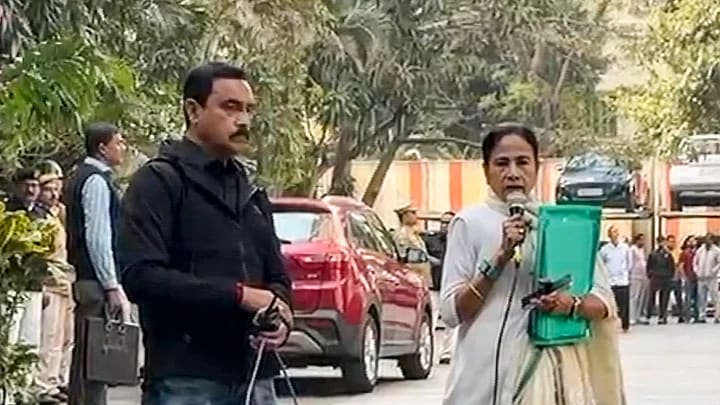
Politics in West Bengal is at a boiling point. On January 8, 2026, the Enforcement Directorate (ED) and Income Tax department raided the Kolkata office of the Indian Political Action Committee (I-PAC) and the residence of its head, Prateek Jain. It was reported that the organization was involved in hawala transactions. Upon hearing the news of the raid, Chief Minister Mamata Banerjee herself arrived at the scene and confronted the ED officials. She filed an FIR against them and took away the seized documents and hard drives.
She alleged that the raid on I-PAC was an attempt to uncover her election strategy. Mamata Banerjee's action against the ED has given opposition parties an opportunity to attack her. The BJP termed it an obstruction of a federal agency and demanded the imposition of President's Rule in the state.
This incident occurred just before the 2026 assembly elections, when the battle between the TMC and the BJP is at its peak. The question arises: Is Bengal heading towards President's Rule? And is this an opportune moment for the central NDA government to impose President's Rule under Article 356 and hold elections?
ED Raid and Mamata's Intervention
The ED raid is reportedly linked to a fake government jobs scam, where an organized gang defrauded people by promising them jobs. During the investigation, the ED traced funds linked to the coal scam to I-PAC, which were allegedly used for the TMC's Goa election campaign in 2022.
Prateek Jain, the co-founder of I-PAC, is also the head of the TMC's IT cell and a key election strategist for Mamata Banerjee. The organization was founded by Prashant Kishor, the founder of Bihar's Jan Suraj Party, who managed Mamata's previous campaign. The ED claims that Mamata Banerjee seized documents and electronic evidence during the raid.
Mamata, however, termed it political vendetta and called Union Home Minister Amit Shah "nasty" and a "naughty Home Minister." She alleged that the ED was trying to steal TMC's internal data, candidate lists, and election strategy. Mamata herself took the files and laptops, which was captured on video.
This is not the first time Mamata has clashed with central agencies. In 2019, she staged a sit-in during a CBI raid, and in 2021, demands for President's Rule arose after post-election violence. But this time, just before the elections, the incident seems more serious. The ED has filed a petition in the Calcutta High Court, where IPAC and TMC have also filed petitions. Legal experts say that being a Chief Minister does not provide any constitutional immunity from arrest, and if the ED proves that the files are related to the investigation, Mamata could face serious consequences.
Opposition demands: Arrest and President's Rule
Following the incident, the opposition intensified its attack on Mamata. CPI(M)'s Mohammed Salim said that Mamata protected Jain because all the corruption documents are with her. The Congress alleged that IPAC raised funds for the TMC and provided conspiratorial assistance in winning the elections. Both parties demanded Mamata's immediate arrest. The BJP termed it a defense of corruption and questioned why the Chief Minister took the files from the investigation site if there was nothing to hide. The demand for President's Rule is also gaining momentum.
The Leader of the Opposition in the Bengal Assembly, Suvendu Adhikari, said that Mamata has created a constitutional crisis. This demand is based on Article 356, which allows the central government to impose President's Rule in a state if the constitutional machinery breaks down. Historically, Bengal has been under President's Rule in 1968, 1970, and 1971, but the state has not seen President's Rule since the TMC came to power in 2011. The BJP had demanded it after the 2021 post-election violence, but the central government did not heed the demand. The Possibility of President's Rule and the Circumstances of Articles 356 and 365
Legal and Political Aspects: Is Bengal heading towards President's Rule? The current situation suggests yes, but it's not that simple. Under Article 356, the Centre can impose President's Rule based on the Governor's report, but the Supreme Court's S.R. Bommai case (1994) judgment has limited this.
It stated that President's Rule can only be imposed when the constitutional machinery in the state has completely broken down, and the Centre has to prove its majority in Parliament. Currently, Mamata's alleged interference in the investigation could be considered obstruction of justice, which is an offense under Section 186 of the IPC. The ED is empowered under Section 67 of the PMLA, which grants investigating officers broad powers. If the ED proves that Mamata destroyed evidence, arrest is possible. However, the state police have filed an FIR against the ED officials themselves, escalating federal tensions.
According to Article 365 of the Constitution, if a state government fails to comply with any specific direction given by the Centre (on matters over which the Union has jurisdiction), the President may conclude that the constitutional machinery in the state has failed.
This provides an additional and strong ground for imposing President's Rule under Article 356.
However, politically, the TMC has a strong hold in Bengal. It won 213 seats in 2021, and the party secured 29 seats in the 2024 Lok Sabha elections. But the ED-CBI investigations...
TMC leaders like Abhishek Banerjee are affected. If Mamata is arrested, chaos could erupt, which could provide grounds for President's Rule. However, this is difficult under the Supreme Court's supervision.
When has the threat of dismissal loomed over Mamata Banerjee's government?
Mamata Banerjee's government has faced the threat of dismissal several times, but she has survived. There are several incidents that justify President's Rule under Article 356.
- Hundreds of deaths occurred in the violence after the 2021 elections, in which BJP workers were targeted. The Supreme Court also demanded an investigation into this.
- The government's inaction has been evident in the Sandeshkhali incident, involving atrocities against women and allegations of land grabbing.
- TMC leaders have been involved in cases like the coal scam, job scam, and the Saradha chit fund scam. Mamata herself dismissed several ministers under pressure.
- Top leaders like Abhishek Banerjee are facing allegations in ED-CBI investigations. Mamata's interference in the iPAC raid, obstructing the investigation, is a major factor. This has created a constitutional crisis in the state. Earlier, the ED team that went to investigate the Sandeshkhali case was attacked. The officers had a hard time saving their lives.
There was a time when governments were dismissed for minor reasons.
Until the judgment in the S.R. Bommai case (1994), state governments were dismissed for minor and trivial reasons. In Punjab, it was used for the first time in 1951, just 17 months after the Constitution came into effect. It was imposed due to internal strife after Chief Minister Gopichand Bhargava's resignation. There was no major constitutional crisis, only internal disputes within the Congress. This is considered the shortest and earliest instance of misuse.
In 1959, the first elected Communist government in Kerala (E.M.S. Namboodiripad) was dismissed. The reason was simply the protests and violence surrounding the education reform bill. In Karnataka, the government was dismissed in 1990 due to internal strife. Indira Gandhi dismissed state governments 39 times between 1966 and 1977. After her return to power in 1980, Indira Gandhi dismissed nine opposition-led state governments simultaneously. The Sarkaria Commission stated that the Act was misused in 52 out of 75 cases of government dismissals.



Discussion (0)
Leave A Reply
Speak Truth To PowerModerated by Times Indian