

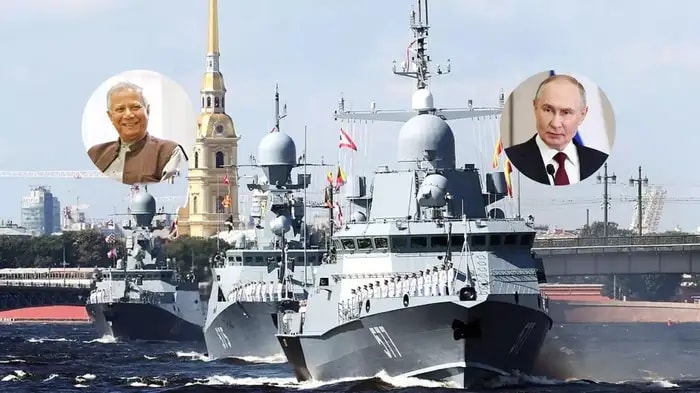
Dhaka: Three warships of the Russian Navy are on a visit to Bangladesh. This incident has happened when the Bangladesh Army Chief had visited Russia a few days ago. The warships of the Russian Navy that have reached Bangladesh include Rezki, Hero of the Russian Federation Aldar Tsydenzhapov and Pechenga. These three warships reached Bangladesh's Chittagong port on Monday, which has been built by China with its own money. These warships will remain in Bangladesh for the next four days. In such a situation, the question arises whether Bangladesh is now leaving America and moving closer to Russia. If yes, how will China benefit from it?
Bangladesh Army Chief on Russia visit
According to the Economic Times, these ships have arrived in Bangladesh less than a week after Bangladesh Army Chief General Waqar-uz-Zaman's visit to Moscow. Zaman met both civilian and military leadership in Moscow. He also visited Russian weapons manufacturing facilities. The Russian warships were welcomed by Bangladeshi Navy ship BNS Khalid Bin Walid in Bangladeshi waters.
Russian warships arrive on goodwill visit
According to the Daily Observer, the Russian warships are in Bangladesh on a goodwill visit. According to the New Age, the ships were welcomed by the Chief Staff Officer of the Chittagong Naval Area and high-ranking officials of the Bangladesh Navy. The Russian Ambassador to Bangladesh, military, air and naval attaches and the Russian Honorary Consul in Chittagong were also present. A Russian delegation, including the captains of the Russian Navy's warships and the Russian Ambassador to Bangladesh, is scheduled to pay courtesy calls on the Commander of the Chittagong Naval Area, the Commander of the Bangladeshi Fleet and the Chairman of the Chittagong Port Authority.
What is the purpose of the Russian ships
According to a release issued by the Bangladesh Navy, "The goodwill visit will further strengthen bilateral relations, exchange views on professional matters and create opportunities for future training and mutual cooperation between naval officers and sailors of the two countries." The ships are scheduled to leave the country on April 16.
Bangladesh wants to remove dependence from China
According to the Economic Times, this visit is an indication that Bangladesh is looking at options other than China for its military needs. The newspaper quoted experts as saying that Bangladesh wants to expand its military partnership to reduce its dependence on China. The Bangladesh Army is heavily dependent on Chinese equipment. In such a situation, it also wants to strengthen its military ties with Russia.
Bangladesh buys large quantities of weapons from China
According to the Statesman, in recent years Bangladesh has been the second largest importer of Chinese weapons after Pakistan. From 2019 to 2023, Bangladesh imported 11 percent of all Chinese weapons exported globally. During the same period, Bangladesh bought 72 percent of all its weapons from China. According to the Stockholm International Peace Research Institute, Bangladesh has spent $2.59 billion on arms purchases from China from 2010 to 2019.
Know Bangladesh's defense relations with China
The SIPRI report said, "Dhaka has purchased important weapons from Beijing, including maritime patrol ships, corvettes, tanks, fighter jets, and surface-to-air and anti-ship missiles." About 86 percent of its military imports come from China. These include naval guns, anti-ship missiles, surface-to-air missile systems and corvettes.
Yunus will not betray America
Mohammad Yunus is considered a disciple of America. It is said that former US Presidents Bill Clinton and Barack Obama have contributed a lot to whatever he is today. This friendship of Yunus with the Democratic Party of America was also seen during his visit to America last year, when he met the then US President Joe Biden. Not only this, the US pressure is also said to be behind the appointment of Mohammad Yunus as the head of the interim government of Bangladesh. In such a situation, seeing his growing closeness to China and Russia, there is a fear that Mohammad Yunus may change sides.

Discussion (0)
Leave A Reply
Speak Truth To PowerModerated by Times Indian