

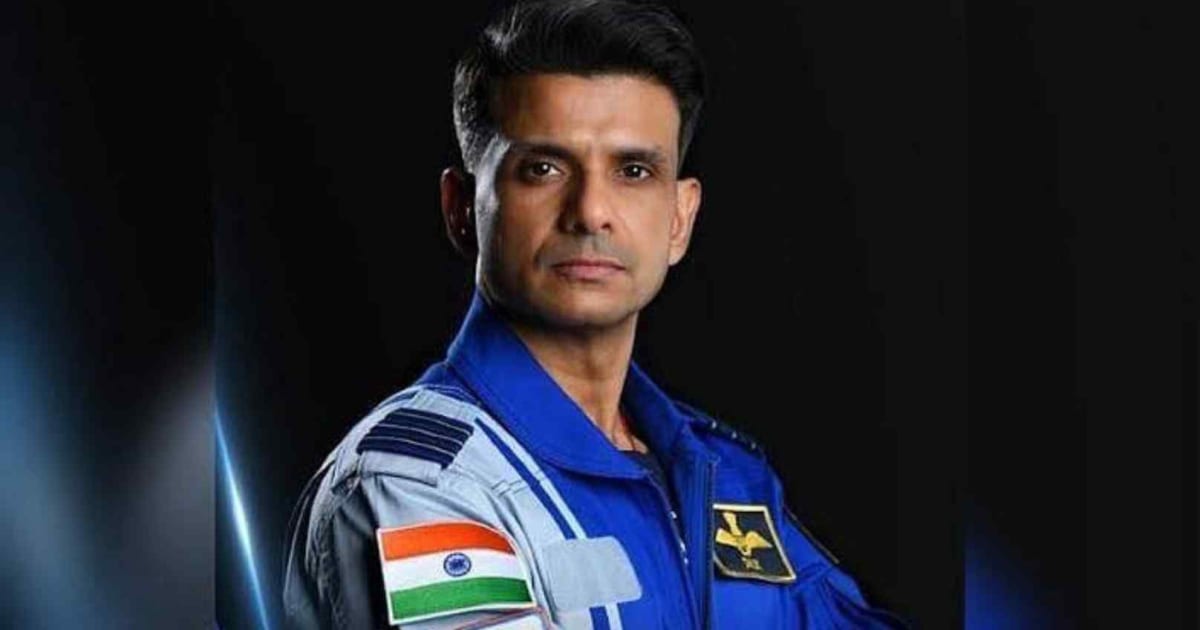
New Delhi: Indian Air Force Group Captain Shubhanshu Shukla has left for the International Space Station under the Axiom-4 mission. He took this flight with his colleagues from the Kennedy Space Center (KSC) in Florida, USA, aboard the 'SpaceX Falcon 9' rocket. India has got this achievement 41 years after Wing Commander Rakesh Sharma traveled to space under the Soviet mission in 1984. This space mission will connect with the ISS on June 26 at around 4 pm. The entire journey will take about 28 hours. This mission has created an atmosphere of excitement across the country.
As soon as Shubhanshu Shukla, a resident of Lucknow, boarded the 'SpaceX Falcon 9' rocket and flew to space, tears rolled down his parents' eyes. Both of them looked very emotional while encouraging their son.
Who else was sent with Shubhanshu Shukla?
Let us tell you that in this space mission, along with Group Captain Shubhanshu Shukla, Mission Commander Peggy Whitson (USA), Mission Specialist Tibor Kapu (Hungary), Poland's Slavos Wujnanski-Vishnevsky (Mission Specialist) and a scientist from the European Space Agency also flew to space.
What is the 14-day plan in space?
- Under this mission, Shubhanshu Shukla will stay in space for 14 days. During this time, his entire team will conduct 60 scientific experiments. Seven of these experiments are proposed by Indian researchers. Group Captain Shukla can also talk to a special person from space.
- Will conduct experiments on these important topics
- Muscle regeneration in space is an important topic. Scientists are looking at the effect of nutritional supplements on muscles in microgravity. This will reveal how to keep muscles healthy in space. This research can also be useful for muscle diseases on Earth.
- Germination of moong and fenugreek seeds is also an important study. Scientists are looking at how these seeds grow in space. This will help in farming in space. It can become a source of food for astronauts in future.
- Microalgae is being considered as the superfood of the future. The growth of microscopic algae like spirulina and cyanococcus is being studied. These algae are a good source of protein and can be useful in closed-loop life support systems.
- The vitality of tardigrades is surprising scientists. Tardigrades, also known as water bears, can survive even in the extreme conditions of space. Scientists are studying their survival and fertility.
- Human behavior in microgravity is also being studied. Scientists are looking at how eye-hand coordination and cognitive functions are affected by the screen. This is called "human-technical interaction".
- Six crop seeds have also been sent to space. Scientists are looking at what changes occur in these seeds during space travel. This is part of India-focused agricultural research.
The stress caused by the use of computer screens is also being studied. Scientists are analyzing changes in eye movement and use.
The aim of all these experiments is to make life in space easier and better. People are now eagerly waiting for Shubhanshu Shukla's achievement.


Discussion (0)
Leave A Reply
Speak Truth To PowerModerated by Times Indian