

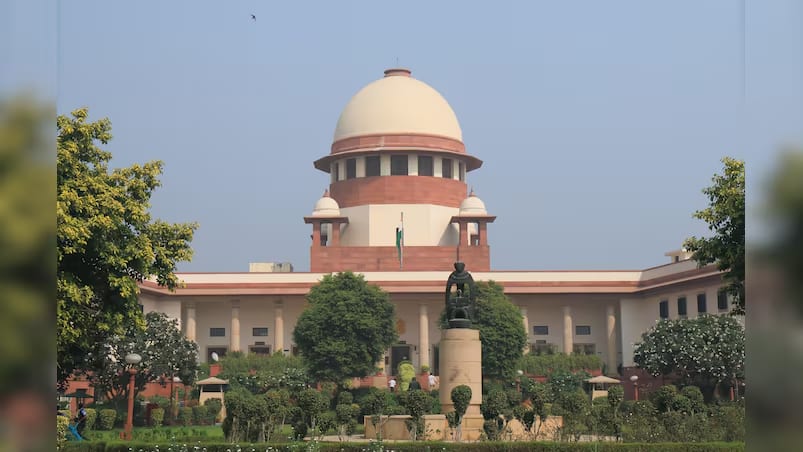
New Delhi: The three-day hearing on petitions challenging the constitutional validity of the Waqf Amendment Act in the Supreme Court has been completed. The apex court on Thursday reserved its interim order on three issues. This also includes the power to de-notify properties declared 'waqf by courts, waqf by user or waqf by deed'.
A bench of CJI BR Gavai and Justice Augustine George Masih heard the petitions opposing the amended Waqf Act. The arguments of senior advocates Kapil Sibal, Rajiv Dhawan and Abhishek Singhvi appearing on behalf of these petitions and Solicitor General Tushar Mehta representing the Center were heard for three consecutive days, after which it reserved its interim order.
The Center supported the Waqf law
The Center strongly supported this act and said that Waqf is a secular concept by its nature. It cannot be banned because the concept of constitutionality is in its favor. At the same time, Kapil Sibal, who is advocating for the petitioners, described this law as a complete departure from historical legal and constitutional principles and a means of capturing Waqf through non-judicial process.
CJI Gavai said - Moksha in Hinduism too....
The Supreme Court said that religious charity is not limited to Islam only. CJI BR Gavai said that there is a concept of Moksha in Hinduism too. Charity is a fundamental concept of other religions as well. Justice Augustine George Masih, the second judge of the bench, said that a similar provision is mentioned in Christianity. It has the aspiration of heaven.
What Kapil Sibal said during the hearing
Kapil Sibal said that this is a case of systematic occupation of Waqf properties. The government cannot decide which issues can be raised. At the present stage, the petitioners have requested to pass an interim order on three major issues. The first of these issues is related to the power of the courts to de-notify properties declared as Waqf, Waqf by User or Waqf by Deed.
Three issues discussed in the apex court
The second issue is related to the structure of the State Waqf Board and Central Waqf Council. The petitioners argue that except the ex-officio members, only Muslims should work in the State Waqf Board and Central Waqf Council. The third issue is related to the provision which states that when the collector investigates to find out whether the property is government land or not, the waqf property will not be considered a waqf.
The Center had given an affidavit in the Supreme Court
The Union Ministry of Minority Affairs had filed a preliminary affidavit of 1,332 pages on April 25 supporting the amended Waqf Act 2025. The apex court had opposed the ban on such a law passed by Parliament, which has the 'presumption of constitutionality' in its favor. The Center notified the Waqf (Amendment) Act, 2025 last month. It got the approval of President Draupadi Murmu on April 5.
Waqf law passed by Lok Sabha and Rajya Sabha
The Waqf Amendment Bill was passed in the Lok Sabha with 288 members voting, while 232 MPs were against it. In the Rajya Sabha, 128 members voted in favor and 95 in opposition. On Thursday also, several petitions challenging the new Waqf law were heard in the Supreme Court. Solicitor General Tushar Mehta presented arguments on behalf of the Central Government before the bench of Chief Justice BR Gavai and Justice AG Masih.
If the law is unconstitutional then... SG Tushar Mehta gave this argument
Solicitor General Tushar Mehta, while opposing any kind of interim order, argued that if after the final hearing the court feels that the law is unconstitutional, then the court can cancel it. But, if the court puts a stay on the law with an interim order and during this time any property goes to the Waqf, then it will be difficult to get it back, because Waqf belongs to Allah and once it becomes Waqf, it will not be easy to get it back.
Creating a Waqf and donating to Waqf are different - SG
Solicitor General Mehta said that creating a Waqf and donating to Waqf are both different. This is the reason why 5 years of practice is required for Muslims, so that Waqf is not used to cheat anyone. Tushar Mehta told the Supreme Court that suppose I am a Hindu and I want to donate for Waqf, then also donation can be made to Waqf.
What else did the Solicitor General say
Referring to the tribal area, the Solicitor General said that in case of increase in Waqf properties in tribal areas, no common man can buy land there, because the state law does not allow it. But, if the same person wants to do Waqf, then after doing Waqf, the Mutawalli (trustee or caretaker) can do whatever he wants. This system is so dangerous that it needs to be stopped.
Tushar Mehta argued before the bench that the Supreme Court has said in one of its decisions that under Article 12 of the Constitution, Waqf is a state in itself. In such a situation, it cannot be argued that only people of one community will be included in it. Solicitor General TusharMehta, while presenting the government's side on Wednesday, had said that the government wants to ensure the trust's land for all citizens.
Tushar Mehta had said that before the amendment of the Waqf Act 2013, all versions of the Act stated that only Muslims could waqf their property. But, just before the 2013 general elections, an amendment was made, according to which anyone can waqf their property. Earlier, during the hearing on Tuesday, CJI BR Gavai had mentioned a temple in Khajuraho.
Kapil Sibal presented his arguments
The Solicitor General had said that the temple is under the protection of the Archaeological Department and yet people can go there and worship. On this, Kapil Sibal argued that the new law says that if it is an ASI protected area then it cannot be a waqf. On this, Kapil Sibal argued that the new law says that if it is an ASI protected area then it cannot be a waqf.


Discussion (0)
Leave A Reply
Speak Truth To PowerModerated by Times Indian