

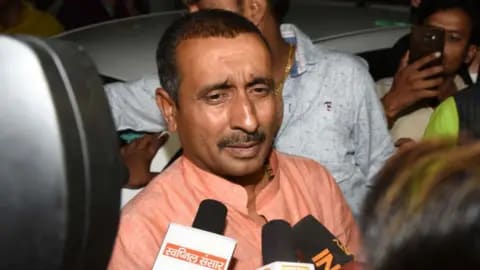
New Delhi: The Supreme Court has stayed the Delhi High Court order that granted significant relief to expelled BJP MLA Kuldeep Singh Sengar in the Unnao minor rape case. The apex court clarified that Sengar will not be released from jail based on the High Court's order of December 23, 2025. The court said that several important legal questions have arisen in the case that require consideration. The High Court had granted bail to Sengar by suspending his sentence, which was challenged by the CBI in the Supreme Court. The Supreme Court stayed the High Court's order on Monday.
A bench headed by Chief Justice Surya Kant, while hearing the CBI's petition on Monday, issued a notice and directed that a reply be filed within four weeks. The bench said that usually, when a convict or an undertrial prisoner is released, such orders are not stayed without hearing them, but the circumstances are different in this case because Sengar is also convicted in another case and is in jail.
Solicitor General Tushar Mehta, appearing for the CBI, told the court that this is an "extremely heinous" case of rape of a minor. He informed the court that Sengar was charged under Section 376 of the IPC and Sections 5 and 6 of the POCSO Act, and the trial court had convicted him. The SG said that the victim was less than 16 years old at the time of the incident; she was 15 years and 10 months old. Therefore, this penetrative sexual act is an independent offense in itself. Mehta argued that the amendment did not create a new offense, but merely enhanced the punishment. He also stated that Section 42A of the POCSO Act clearly states that if there is a conflict with any other law, POCSO will prevail, but the High Court did not consider this aspect.
Debate on the definition of 'Public Servant'
The most crucial debate during the hearing revolved around the definition of a 'public servant'. SG Mehta stated that if a person is in a dominant position over the victim, the offense would be considered 'aggravated'. He gave the example that if a constable or an army officer on duty commits such an act, it would fall under the category of an aggravated offense. The Chief Justice questioned whether this meant that a public servant is only someone who is in a dominant position at that time. The CJI remarked that it would be an odd situation if a constable were considered a public servant under POCSO, but a Member of the Legislative Assembly (MLA) were not.
Defense Arguments
Senior advocates Siddharth Dave and N. Hariharan, representing Sengar, justified the High Court's order and stated that Section 2(2) of POCSO was not cited, and the sentence was based on the definition of a public servant in the IPC.
Supreme Court's Observations
Justice J.K. Maheshwari questioned why the High Court's order suspending the sentence did not clearly state whether Sengar was convicted under Section 376(2)(i) of the IPC. The CJI said that the High Court judges are highly competent, but errors are possible for everyone, and that is why a reconsideration of the legal questions in this case is necessary. At the end of the hearing, the Supreme Court stayed the implementation of the Delhi High Court's order of December 23, 2025, stating that since Sengar has also been convicted and is in jail in the case of the victim's father's murder, he will not be released. Further hearings in this case will now take place in the Supreme Court, where it will be decided what the definition of a 'public servant' under the POCSO Act will be and what the criteria for suspending sentences in such cases should be.


Discussion (0)
Leave A Reply
Speak Truth To PowerModerated by Times Indian