

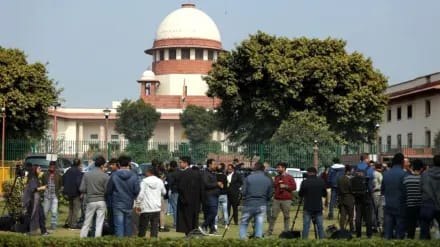
New Delhi: The Supreme Court will hear the petitions challenging the constitutional validity of the Waqf (Amendment) Act, 2025. The court can also issue an interim order in this matter. On May 15, a bench of Chief Justice BR Gavai and Justice AG Masih had adjourned the hearing till May 20. He had said that he would hear the debate on three main issues to issue interim instructions. Let us understand from legal experts about these three issues, on which the Muslim side has the most objections. Earlier, a bench headed by former Chief Justice Sanjeev Khanna was hearing this case. After the retirement of Justice Khanna on May 13, the case was transferred to the bench headed by Justice BR Gavai. After the retirement of Justice Khanna, now Justice Gavai's bench will look into this matter. Muslims of Pakistan, Bangladesh and Turkey are eyeing it.
First issue: Waqf by user
The first issue in the Supreme Court is related to the declaration of properties as Waqf which were declared as Waqf either through "Waqf by user" or "Waqf by deed". "Waqf by user" means properties that have been used as Waqf property for a long time, even if there is no written Waqf deed or formal document. Such properties are considered Waqf on the basis of being used for a long time.
Second issue: Structure of Waqf
The second issue raised by the petitioners is related to the structure of the State Waqf Boards and the Central Waqf Council. The petitioners argue that apart from ex-officio members, only Muslims should be allowed to manage these bodies. They say that the Waqf Board and Council should have only Muslim members.
Third issue: Collector's investigation
The third argument is a provision which states that if the collector investigates whether a property is government land or not, such property will not be considered as Waqf property during the investigation. Meaning, if the collector suspects that a land is government land, it will not be considered as Waqf land till the investigation is done.
No interim stay on original Waqf law
The bench had directed senior advocate Kapil Sibal, appearing for the petitioners, and Solicitor General Tushar Mehta, representing the Central Government, to submit their written notes by May 19. However, the court made it clear that it will not consider requests for an interim stay on the original Waqf Act of 1995. The court has clearly said that it will not put any stay on the Waqf Act 1995.
What did the central government say in the last hearing
In the last hearing, the central government had assured the court that the currently registered and notified Waqf properties, including those under "Waqf by User", will not be denotified for the time being. The government also said that non-Muslim members will not be appointed to the Central Waqf Council or State Waqf Boards. The government has said that the Waqf properties that are there now will be considered as Waqf and there will be no non-Muslim members in the Waqf Board.
The process of forming a Waqf Board is in trouble
Kapil Sibal, who is arguing against the law, said, "We challenge the provision which states that only Muslims can create Waqf. How can the government say that only those people can create Waqf who have been following Islam for the last 5 years? Sibal said - Waqf has been created hundreds of years ago. Now they will ask for the Waqf deed of the 300-year-old property. On this, SG said- Waqf registration was also in the 1995 law. Sibal sahab is saying that the Mutwalli will have to go to jail. If the Waqf is not registered, he will go to jail. This is from 1995. On this, the Supreme Court had said, before the British, there was no Waqf registration. Many mosques are from the 13th, 14th century. They will not have registration or sale deed. How will they register such properties. What documents will they have? Waqf by user has been approved, if you end it then there will be a problem.
What is the problem with non-Muslims in board members?
Sibal said, earlier only Muslims could be a part of the Waqf Board. Now Hindus will also be a part of it. This is a violation of rights. Article 26 says that citizens can establish an institution for religious and social service. There was a heated debate between CJI and SG on this issue. The court asked whether the government will include Muslims in the Hindu religious board? The SG said that apart from the ex-officio members, there will not be more than two non-Muslim members in the Waqf Council. On this, the bench said - In the new Act, out of the 22 members of the Waqf Council, eight will be Muslims. There can be two judges in it who are not Muslims. In such a situation, the majority will be of non-Muslims. How will this save the religious character of the institution?
The Waqf Act has been challenged on these grounds
The Waqf Amendment Act has been challenged in the Supreme Court under Articles 25, 26, 29 and 30 of the Constitution. It has been said that religion is a personal matter of anyone. In such a situation, the government cannot interfere in this matter by making a law. Many people including many NGOs, Muslim organizations and opposition Congress of the country had filed a petition in the Supreme Court against this law.
But the Supreme Court had said that it would hear only selected petitions. These issues have been raised in the previous hearing.
Does the new Waqf law violate Article 25?
The petitioners say that the new Waqf law violates Article 25 of the Constitution i.e. the right to religious freedom. Under this article, every person in India has the right to believe in religion according to his conscience, follow his traditions and propagate it. Also, any financial, economic, political or other secular activity related to any religious practice cannot be controlled and banned. This article gives the right to manage property and institutions according to one's religious beliefs. In such a situation, if the management of Waqf properties changes or non-Muslims are included in it, then it may violate religious freedom.
Does the Waqf law violate Article 26?
According to the petitioners, the new Waqf law also violates Article 26. This article gives the religious community the right to maintain its religious organizations. But now the new Waqf law will take away the right to manage religious institutions. Similarly, taking away the rights of minorities is considered a violation of Articles 29 and 30. The purpose of these articles is to protect the interests of minority classes and promote their culture, language and education.
What is there in Articles 29-30, know here
Any citizen class has the right to maintain its separate language, script or culture. There will be no discrimination on the basis of religion, race, caste, language or any of them. At the same time, Article 30 gives the right to educational institutions of minority classes. Under this, minority communities have the right to establish and administer an educational institution of their choice for the preservation of their culture and heritage. There will be no discrimination against any educational institution run by any minority group, regardless of religion or language, while giving aid by the government. The admission process in minority educational institutions can be based on entrance examination or merit and the state has no right to reserve seats in them.
Will the collector's rights be restricted?
The second question is whether the collector's rights should be restricted in case of a dispute. There is a new provision in the Waqf Act. According to this, if there is a dispute over any Waqf property, the collector will investigate it. This dispute can be related to the settlement of government land or Waqf land. During the investigation, the Waqf property will not be considered as Waqf property. The central government says that in case of a dispute, the other party can go to the tribunal.
Kerala government opposes Waqf Act
The Kerala government has decided to oppose the Waqf (Amendment) Act. Now it will challenge this law in the Supreme Court. Law Minister P. Rajeev said that the state government has instructed its legal officers to file a petition in the Supreme Court. In this petition, the government will oppose this law. Earlier the Kerala government was silent on this matter. It was not able to decide whether to oppose the law or not. But, many BJP-ruled states have already filed a petition in the Supreme Court. These states have talked about saving this law passed by the central government.
Waqf property worth Rs 1.2 lakh crore in India
The total property of Waqf in India is 8.72 lakh acres. This property is so much that after the army and railways, Waqf has the most property. In 2009, this property was only about 4 lakh acres, which has now doubled. The Ministry of Minority Welfare had given information in the Lok Sabha in December 2022, according to which the Waqf Board has 8,65,644 acres of immovable properties. The estimated value of these Waqf lands is Rs 1.2 lakh crore.



Discussion (0)
Leave A Reply
Speak Truth To PowerModerated by Times Indian