

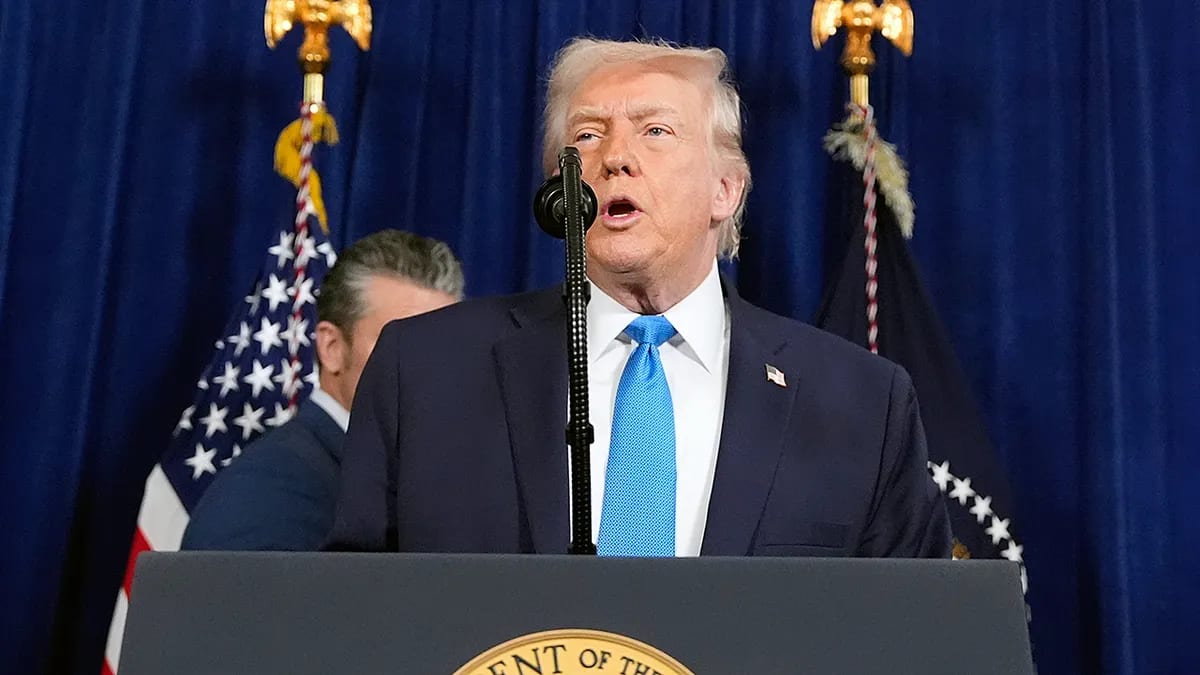
While it remains unclear how the US plans to run Venezuela or who would be involved, Trump said it would be a "collective" effort.
He added that US Secretary of State Mike Pompeo had been speaking with Venezuelan Vice President Delcy Rodríguez, who was later appointed interim president by Venezuela's Supreme Court.
Trump claimed that she had expressed a willingness to "do whatever the US says."
However, Rodríguez later appeared on state television demanding Maduro's release, stating that he was the country's "only president."
Trump also said he had not spoken to Venezuelan opposition leader María Corina Machado, whom he said lacked the support and respect to become a leader in Venezuela.
Machado had previously called for Edmundo González to take power. She had rallied support for González in the 2024 presidential election, and her party released vote counts showing he had won by a landslide.
Trump's accusations against Maduro
Since Trump began his second term last January, he has increased pressure on the Venezuelan government. First, the Trump administration doubled the reward for information leading to Maduro's capture.
In September, the US military began targeting ships suspected of carrying drugs from South America. Since then, there have been more than 30 attacks on such vessels in the Caribbean Sea and Pacific Ocean, resulting in more than 110 deaths. The Trump administration has blamed Maduro for the millions of Venezuelan migrants who have fled to the United States.
Without providing any evidence, Trump accused Maduro of "emptying his prisons and insane asylums" and "forcing" their inmates to migrate to the United States.
The US president also claims the Venezuelan government is using oil money to fund drug-related crimes, and alleged that Maduro himself is a cartel leader.
US Attorney General Pamela Bondi announced the charges against the Venezuelan president and his wife, Cilia Flores, on Saturday.
Nicolás Maduro is charged with "narcoterrorism conspiracy, cocaine importation conspiracy, possession of machine guns and destructive devices, and conspiracy to possess machine guns and destructive devices against the United States."
Later, US President Donald Trump characterized these charges as Maduro's "deadly narcoterrorism campaign" against the United States and its citizens.
He also called Maduro an "illegitimate dictator," and said he had told the Venezuelan leader to "surrender" a week before the charges were filed.
Bondi said that Maduro and his wife will "face American justice in American courts on American soil."
Both are now in custody at a detention center in New York, where they are scheduled to appear in court on Monday.
Maduro has denied the charges against him, accusing the US of using the "war on drugs" as a pretext to remove him and gain access to Venezuela's vast oil reserves. Maduro's Allegations
By Vanessa Buschschluter, BBC Latin America Editor
Maduro has long accused the Trump administration of trying to oust him from power so that the US can control Venezuela's oil reserves.
When the US seized the first oil tanker off the Venezuelan coast, Trump made a statement that Maduro referenced.
When reporters asked what would happen to the tanker and its cargo, the US president said, "I think we'll keep the oil."
US officials have previously denied Venezuela's accusations that the actions taken against the Maduro government were an attempt to gain access to the country's oil reserves.
However, the export restrictions have exacerbated the effects of underinvestment and mismanagement in Venezuela's state-owned oil company.
According to the US Energy Information Administration (EIA), in 2023, Venezuela produced only 0.8% of the world's total crude oil. It currently exports approximately 900,000 barrels per day, and China is by far its largest buyer.

Discussion (0)
Leave A Reply
Speak Truth To PowerModerated by Times Indian