

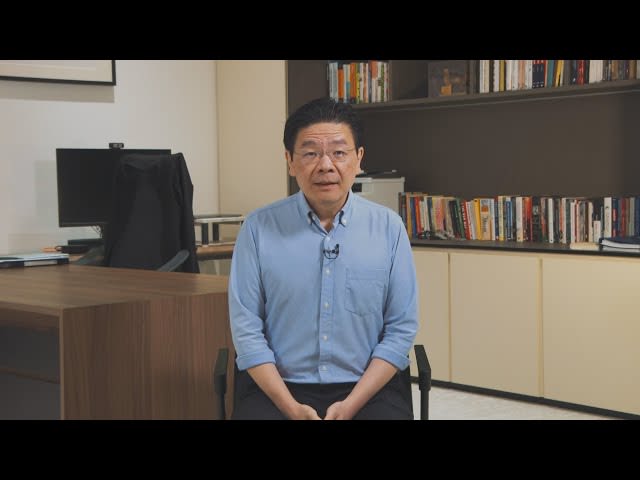
Singapore: Donald Trump has imposed tariffs on most countries in the world. His reasoning behind this is that the purpose of imposing tariffs is to promote the manufacturing sector in America, create jobs and increase the country's economy. But now many experts and countries have started calling Trump's tariff policy dangerous. Singapore Prime Minister Lawrence Wong has cautioned the people of the country in an address and warned about the coming crisis. He has said in a video message, "They should prepare themselves for a period of increasing instability and uncertainty." He warned that "peace and order in the world as before is unlikely to return soon."
In a YouTube message released on Friday (April 4), he issued a warning about Trump's tariff policy and said that "the world is entering a "crisis-ridden" period marked by rising protectionism and geopolitical tensions." He has clearly said that "America's new trade policy is a sign of an earthquake-like change." He said this in the context of the Trump era strategy, in which American trade policies have shifted from "open market" to "selective supply chain" and "trade with friendly countries".
Dangerous prediction of Singapore's Prime Minister
Further, the Prime Minister of Singapore urged the citizens of the country to be mentally prepared, saying, "We cannot expect that the rules protecting small states will still be in place." He said that "we should not fall into complacency. The risks are real. The stakes are high." The effect of this tariff war, which started during Donald Trump's tenure, is now visible on the world. The US is imposing heavy tariffs on China, Russia and some other countries and giving priority to political preferences in trade agreements. The US has also imposed heavy tariffs on allies like India and Canada.
Although the lowest level of tariff (10 percent) has been imposed on Singapore, its economic and strategic consequences can be quite serious. Deputy Prime Minister and Minister of Trade and Industry Gan Kim Yong reiterated these concerns on Thursday. He said that although the direct impact may seem minor at present, Singapore "may need to make adjustments in the coming times." He said that the government will implement additional support measures if needed. He stressed that "households and businesses have to be prepared for difficult conditions."
Does tariff mean the end of globalization?
The dream of globalization, i.e. 'borderless world', is now slowly fading away due to Trump's new tariff policy. In the 1990s and 2000s, globalization meant cheap manufacturing, free trade, and dominance of global companies. But now countries are working hard to keep their borders safe. Donald Trump's "America First" policy has proved to be the biggest setback for global trade. He has imposed tariffs on China, weakened the WTO and ignored multilateral trade agreements. That is, whether it is America, Europe or India, every country is now trying to become self-reliant in strategic sectors. Be it semiconductors or defense technology, now it is not just about profit, but security.
Not only the Prime Minister of Singapore, The Times has said in its report that British Prime Minister Keir Starmer is also preparing to announce the end of globalization. He has also accepted that people are now getting disappointed with the concept of globalization amid the reciprocal tariff announcement by US President Donald Trump. British Prime Minister Starmer is going to address the country for the first time on Monday, and according to the report, during this time he is going to predict the end of globalization. Britain is also in the grip of Trump's tariff, which is going to have a deep impact on its economy. The British Prime Minister argues that Trump's tariff policy is the wrong response, but he also said that the American public has voted for Trump despite his tariff policy, which shows that perhaps the public believes that they are not getting any benefit from free trade and immigration.
Indian Express' Contributing Editor of International Affairs and international affairs expert C Raja Mohan has written that "The way forward for everyone is unknown and difficult. India will also need a new wave of major internal reforms." He has written that "US President Donald Trump is going to end the era of globalization, in such a situation India will have to forget its approach to international trade developed since the beginning of the 1990s." In the context of India, experts believe that this can be an opportunity for India, but for this India will have to work fast to strengthen Make in India and local manufacturing and only then will it be able to grow.
In the times to come, some degree of self-sufficiency can be achieved.

Discussion (0)
Leave A Reply
Speak Truth To PowerModerated by Times Indian