

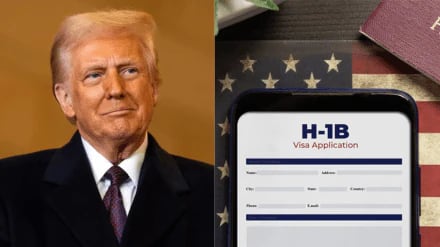
Washington: The US government under Donald Trump has eliminated the random lottery system for H-1B visas. In a major change, the US government has decided that one of the country's most in-demand work visas will now be determined not by chance, but by salary and skills. The Department of Homeland Security has finalized this change, which will replace the long-standing random lottery for H-1B visas with a weighted selection system. Under this change, applicants with higher salaries and more skills will be given priority for visas.
When will the new rule be implemented?
The Department of Homeland Security (DHS) said that the purpose of this change is to prevent misuse of the system and to provide better protection to American workers. According to the report, the new rule will come into effect on February 27, 2026, and will apply to the fiscal year 2027 H-1B cap registration season. Registration for jobs starting on October 1, 2027, is expected to take place in March 2026.
Preference for higher salaries
However, there has been no change in the number of H-1B visas issued each year. It will remain limited to 65,000 under the regular quota, and an additional 20,000 visas will be reserved for those with advanced degrees from US universities. Under the changed rules, registrations will no longer be selected through a random lottery. Instead, they will be weighted based on the employer and salary level. This step has been taken to prevent duplicate filings and misuse of the system.
Major impact on Indians
Under the new rules, those with higher-paying jobs will have a greater chance of being selected. Those with lower salaries will still be eligible for jobs, but their chances of being selected will be lower. This change is expected to have a significant impact on Indian applicants, who consistently make up the largest group of H-1B visa recipients each year. The change comes at a time when the Trump administration is intensifying its efforts to tighten regulations for employment-based visas.
Matthew Tragesser, a spokesperson for U.S. Citizenship and Immigration Services (USCIS), said, "The current random selection process for H-1B registrations has been exploited and abused by U.S. employers," primarily those seeking to hire foreign workers at lower salaries than those paid to American employees. He added that the new system will encourage employers to seek out more highly skilled talent and strengthen America's competitiveness.






Discussion (0)
Leave A Reply
Speak Truth To PowerModerated by Times Indian