

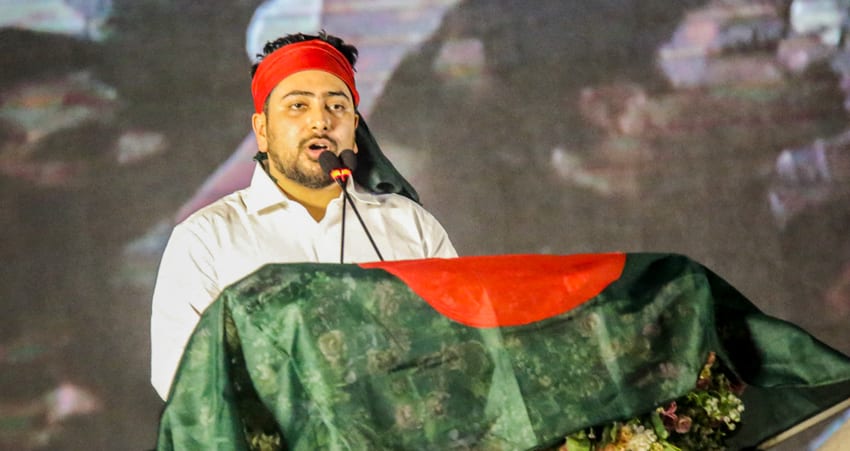
Student Leader Nahid Islam: Sheikh Hasina was ousted from power in Bangladesh last year. The man behind Prime Minister Sheikh Hasina's resignation and fleeing the country is Nahid Islam. Nahid Islam is a student leader and was the coordinator of an organization called 'Students Against Discrimination'. Nahid Islam first came into the limelight when he emerged as the face of student protests, which led to Sheikh Hasina's ouster from power. Then, on Tuesday, he once again came into the news when he resigned from Mohammad Yunus' cabinet. On February 28, he once again came in the news when he announced his new political party.
Nahid Islam is just 27 years old. He was working as an Information and Broadcasting (I&B) advisor in the interim government of Bangladesh. His resignation was not a surprise for many, as rumors of his resignation were going on for about a month. On Friday, Nahid Islam announced a new party at Manik Mia Avenue near Parliament in Dhaka. He has named this party Jatiya Nagrik Party or National Citizen Party (NCP). That is, the organization named 'Students Against Discrimination' has now turned into a political party. In such a situation, the question is whether this party will stir up the politics of Bangladesh? Such possibilities are visible because this new party announced that now there will be no place for pro-India or pro-Pakistan politics in Bangladesh.
Who is Nahid Islam?
Nahid Islam, a sociology student at Dhaka University, became famous at the age of 26 as the face of the anti-reservation protests against Sheikh Hasina. Born in 1998, Nahid has a history of being a critic of the government. In his first week of university in 2017, the Dhaka-born son of a teacher took part in protests against a coal plant in a mangrove forest on the edge of the Sundarbans bordering India. Two years later he participated in university elections and later formed a student organization called the Democratic Student Force at Dhaka University along with his peers.
When did he first come into the limelight
In July 2024, Nahid came into the limelight when he was kidnapped and tortured by the country's intelligence agencies. According to a media report, while recalling the incident, he told that on the night of July 19, about 30 police officers in plain clothes reached his friend's house, where he was hiding to avoid arrest for his role in the ongoing anti-reservation protests. “They tied a black cloth on my head and told me the world will never see you again,” Nahid said.
Kept in secret prison and beaten
In a report by Time, she described what she called a “secret prison” and was beaten with something that looked like an iron rod. A day later, she was dumped near a bridge. She claims she was kidnapped again on July 26 from Dhanmondi’s Gonoshasthaya Municipal Hospital. At that time, she said that individuals claiming to be from various intelligence agencies, including the Detective Branch of the Dhaka Metropolitan Police, took her away. However, all this did not deter Nahid and she continued her criticism against Sheikh Hasina’s administration as one of the national coordinators of the ‘Discrimination against Students’ movement.
‘Hasina must resign’
On August 3, she also made a clarion call from the Dhaka University campus that ‘Hasina must resign’. On August 5, as millions of protesters thronged Sheikh Hasina's residence in central Dhaka, she boarded a ship and left for India, where she is in exile. After Hasina was ousted from power, she was appointed information adviser in the Mohammad Yunus cabinet. In October last year, she was also included in Time magazine's prestigious 'Time 100 Next List'.
Why did Nahid resign from the ministerial post?
After working for six months in Mohammad Yunus' interim government, Nahid tendered her resignation on February 25. On her decision to step down, Nahid said, "Given the current situation in the country, the emergence of a new political force is necessary. I have resigned to stay on the streets to strengthen the mass uprising. Apart from two ministries, I also had to take additional responsibilities... Six months is a very short time, and people will evaluate (the results of my work). From today, I am no longer in any government position." He said it was up to the Advisory Council to decide who would replace him. “The student advisors in the government will remain active in implementing the promises of justice and reform to which the government is committed,” he said. “The interim government had to face many obstacles and bureaucratic complexities. We hope that the government will succeed in realising the aspirations of the people's uprising,” he said.
What's next for Nahid?
At the time of his resignation, Nahid Islam also announced that he would form a new political party. He had earlier written on Facebook, "I joined the government in August, and took the responsibility of fulfilling the aspirations of the martyrs, fighters and people of the July uprising. But this dream cannot be realized only from within the government. That is why today I am ending my membership with a commitment to form a new political force." He said, "The struggle is not over yet, it has just begun in a new form." The party is a collaboration between Students Against Discrimination (SAD) and Jatiya Nagrik Samiti (JANAC). JANAC is a political platform formed after the July uprising. The new party will contest the upcoming elections, which may be held by the end of 2025.
Inspired by Kejriwal
Samantha Sharmin, spokesperson of the Citizens' Committee, said the new party would be similar to Turkey's Recep Tayyip Erdogan-led AK Party, Pakistan's Tehreek-e-Insaf and India's Aam Aadmi Party led by Arvind Kejriwal. "It will be a centrist party with an ideology different from the current main political parties," she told Business Standard. Many political pundits believe that if elections are held in Bangladesh in late 2025 or early 2026, it would be very beneficial for Nahid and her party.
Good timing for Nahid
This is happening when both the major parties of the country - the Awami League and the Bangladesh Nationalist Party (BNP) - are facing difficulties. As soon as Sheikh Hasina left the country, many leaders of her party Awami League fled the country. Those who could not flee have gone into hiding for fear of legal troubles. Moreover, the Yunus government has announced that the Awami League will not be allowed to participate in the elections. And even if they are allowed, there is a lot of anger against the Awami League and this could harm their chances in the elections.
Khaleda's party is also struggling
On the other hand, the opposition party BNP led by Khaleda Zia is also struggling as its members are fighting among themselves. Moreover, the BNP feels that its traditional vote bank has eroded and the young voters have no loyalty to any political party. As The Print reported, Bangladesh's Gen Z and Gen Alpha are living in an ideology-less world, where things are circumstantial and political systems are based on socio-cultural issues. The BNP does not understand this new language and is at risk of being 'cancelled'. In such a situation, only time will tell whether Nahid Islam will be the king or the kingmaker in Bangladesh politics.



Discussion (0)
Leave A Reply
Speak Truth To PowerModerated by Times Indian