

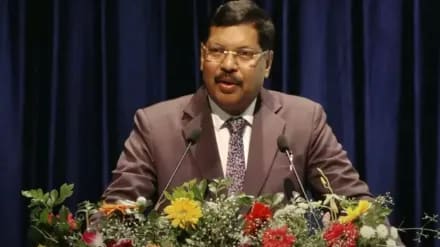
New Delhi: Senior-most judge of the Supreme Court Justice BR Gavai will be the next Chief Justice of India i.e. CJI. Current CJI Sanjiv Khanna has sent the recommendation of Justice Gavai's name as his successor to the Law Ministry. As per tradition, the Law Ministry had sought the recommendation of the name of his successor from the current CJI. In response to this, CJI Khanna put forward the name of Justice Bhushan Ramakrishna Gavai. The appointment of Justice Gavai is special in many ways, as he is going to become the second Dalit Chief Justice of the country.
Will take charge as new CJI in May
The term of Justice Sanjiv Khanna ends on May 13. After him, on the basis of seniority, Justice BR Gavai will take over as the next CJI. Justice Gavai will be the 52nd Chief Justice of the country. He was promoted as a Supreme Court judge on May 24, 2019. His tenure as Chief Justice will be more than six months and he will retire on November 23, 2025.
Know who is Justice BR Gavai
Born in Amravati, started practicing law in 1985
Justice Bhushan Ramakrishna Gavai was born on 24 November 1960 in Amravati district of Maharashtra. He started practicing law on 16 March 1985. In his early years, he worked with former Advocate General and High Court judge Barrister Raja S. Bhosale till 1987. After this, he practiced independently in the Bombay High Court from 1987 to 1990.
Practiced in Bombay High Court till 1990
Justice Gavai practiced mainly in the Nagpur Bench of Bombay High Court after 1990. Then he was also a permanent lawyer for Nagpur Municipal Corporation, Amravati Municipal Corporation and Amravati University. Apart from this, he regularly advocated for various autonomous bodies, corporations like CCOM, DCVL and many municipal councils of Vidarbha region.
Appointed Public Prosecutor for Nagpur Bench in 2000
Justice Gavai was appointed Assistant Government Advocate and Additional Public Prosecutor in the Nagpur Bench of Bombay High Court from August 1992 to July 1993. On 17 January 2000, BR Gavai was appointed Government Advocate and Public Prosecutor for Nagpur Bench.
Promoted as Supreme Court Judge in 2019
On 14 November 2003, he was appointed as an additional judge of the Bombay High Court and became a permanent judge on 12 November 2005. He presided over a variety of cases on benches in Nagpur, Aurangabad and Panaji, including the Mumbai Chief Bench. On 24 May 2019, he was promoted as a judge of the Supreme Court of India. He will retire on 23 November 2025.
- Justice Gavai gave many important decisions
- Justice BR Gavai has been a part of many Constitution Benches in the Supreme Court. During this time he has given important decisions.
- Justice Gavai was part of the five-judge Constitution Bench, which unanimously upheld the Center's decision to repeal the provisions of Article 370 giving special status to the erstwhile state of Jammu and Kashmir in December 2023.
- Another Constitution Bench of five judges had struck down the electoral bond scheme for political financing. Justice Gavai was also a part of this bench.
- Justice Gavai was also part of the five-judge Constitution Bench which approved the Centre's 2016 decision to demonetise Rs 1,000 and Rs 500 notes by a majority of 4:1.
- Justice Gavai was part of the seven-judge Constitution Bench which by a majority of 6:1 held that states have the constitutional right to make sub-classifications within the Scheduled Castes. So that reservation can be given for the upliftment of those castes which are socially and educationally more backward.
- The Constitution Bench of seven judges including Justice Gavai ruled that the arbitration clause in an unstamped or insufficiently stamped agreement between the parties is enforceable. This is because such a defect can be cured and it does not make the contract illegal.
- In an important decision, the bench led by Justice Gavai issued guidelines at the all-India level, saying that no property should be demolished without giving a 'show cause' notice. The affected people should be given 15 days to respond.
- Justice Gavai is also heading the bench which is hearing cases related to protection of forests, wildlife and trees.


Discussion (0)
Leave A Reply
Speak Truth To PowerModerated by Times Indian