

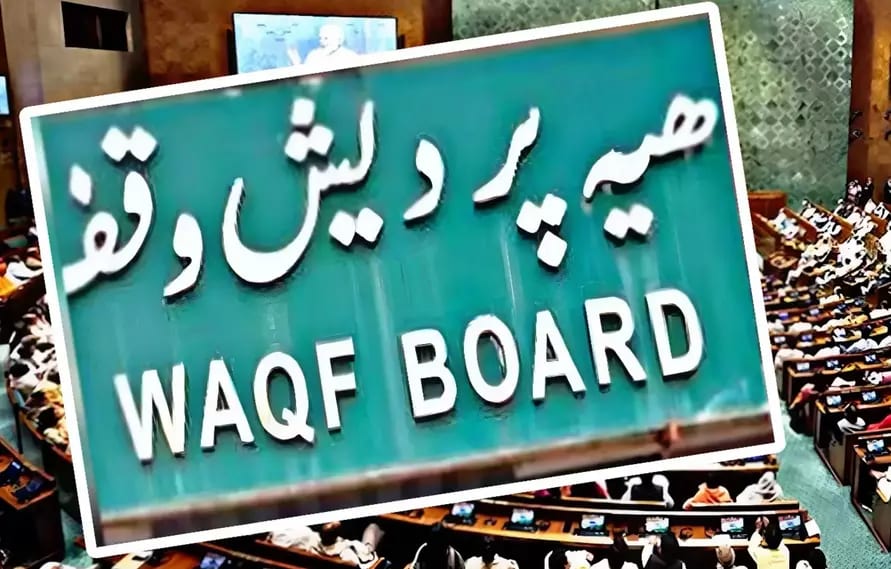
New Delhi: Last week, the Waqf Amendment Bill 2025 was passed in both houses of Parliament after a two-day marathon debate. Now some Muslim organizations in different parts of the country are opposing it. Most opposition parties are supporting these protests and some opposition MPs have already filed a petition in the Supreme Court regarding this bill. It is possible that these protests will end soon, but it is equally possible that they continue for a long time, like the protests against the Citizenship Amendment Act (CAA).
The protesters say the law is unconstitutional because it interferes with the rights conferred by Article 26 of the Constitution, which gives any religious group or denomination the right to establish and administer institutions for religious and charitable purposes, to manage its religious affairs, to own and acquire movable and immovable property, and to administer that property in accordance with law.
What is the government's argument?
The government argues that changes to the current Wakf Act are necessary because the functioning of the Wakf boards is not transparent, leading to many legal disputes - especially because the boards could declare any property as Wakf property. Religious and other properties of non-Muslims were also at risk. In addition, the bill also has the support of some sections of the Catholic community.
The real issue is of mutual trust
But the real issue is not the bill. The real issue is the almost complete breakdown of trust between India's second largest religious population and the government. The question is, how can any government govern or maintain social harmony when this trust is broken?
Remember, even the CAA was not about India’s Muslims, yet it succeeded in hurting them. Today, even though the Waqf Bill improves the governance of Waqf boards and CWCs, a large number of Muslims feel that the government is conspiring against them. And no amount of symbolic efforts—like the ‘Saugat-e-Modi’ kits given to minorities on Eid—can end this mistrust.
This mistrust is also being fuelled by opposition parties, who want the collective vote of minorities in future elections. But this is the same as saying that the BJP wants the collective vote of Hindus. If there is mistrust, it has to be addressed. Symbolism alone will not change anything.
There is mistrust between Hindu and minority communities as well.
This tense situation cannot end unless the government takes steps towards a broader dialogue with Muslims (and Christians). But it must also be noted that this mistrust is not just between the government and minorities, but also between Hindus and minority communities. The government alone cannot solve this problem, even if the general perception is that it is protecting the interests of Hindus only.
Recall the petitions in South India seeking to free temples from state control—the Supreme Court ignored them for over a decade and eventually referred them to the High Courts, even though the Modi government’s counsel supported the idea. But perceptions cannot be changed so easily.
The government must initiate a dialogue
To begin with, the government must initiate a dialogue with the organisations opposing the Waqf Bill. It can promise that whatever demands are genuine—and do not affect other communities or lead to mismanagement of the Waqf again—will be incorporated in the Bill.
But this is followed by a comprehensive dialogue, in which Hindu and Muslim organisations must sit down with each other and clearly lay out their grievances and limitations. Agreements can be based on a spirit of ‘give and take’. Issues can range from cow protection to mob lynching, street namaaz and the moral limits of conversion activities. It is futile to believe that law alone can overcome mistrust, when so many issues are still unresolved and the pain of Partition is still alive today.
Muslims need to introspect too
At the same time, Muslims need to introspect on why the community is so resistant to reform. Why does the Muslim community—the world’s third-largest—with a population of over 200 million—see itself as a victim in every situation?
Moreover, India’s Muslims cannot believe that only what happens to minorities in India matters; they must also care about supporting minorities in their neighbouring countries. Many Hindus did not like the Muslim opposition to the CAA. The Nehru-Liaquat Pact was also implicitly about the protection of minorities in both countries. How can pluralism be protected in India if it cannot be protected in Pakistan, Bangladesh or even the Kashmir Valley?
More importantly, if the demography is changing in many states (like Assam, Kerala, Bengal and parts of UP), then the emerging minorities in these regions are also facing the threat of a minority.
The Muslim majority must assure security and trust to Hindus and other minorities. Majority status in India is legally determined state-wise. But the average Indian district has a population of over 2 million, and the largest district — Thane (now divided) — had a population of 11 million in 2011. In a situation where all communities feel insecure, the legal definitions of majority and minority become irrelevant.
To reiterate, the issue is not the Waqf Bill. The issue is the growing mistrust between the two communities. The government must initiate the process of bridging this gap. Ultimately, the two communities must find a way to live together on the basis of mutual understanding and harmony. Mistrust cannot be left to the law alone.





Discussion (0)
Leave A Reply
Speak Truth To PowerModerated by Times Indian