

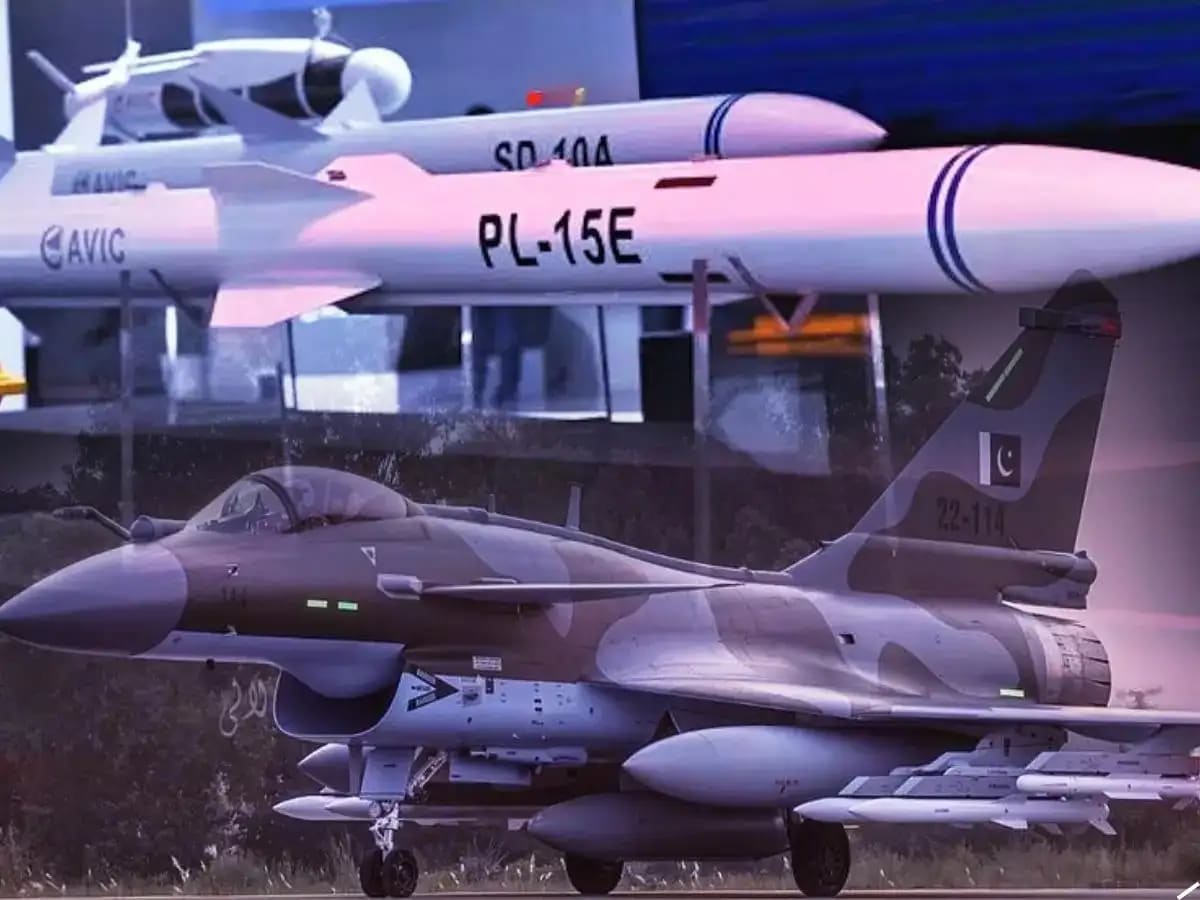
New Delhi: In a press conference on May 11, Air Marshal A.K. Bharti showed some pictures. These pictures were of the Chinese-made PL-15 missile. This missile was found in Punjab. It was fired from a Pakistani fighter plane. At that time, there were almost war-like conditions between India and Pakistan for four days. About seven years ago, when this missile was first shown, it was described as better than the air-to-air missiles of America and Europe. It was said that this missile is at the forefront in terms of range, speed and guidance. But, after the use of this missile during "Operation Sindoor", people have started wondering whether this Chinese weapon has proved to be the best in its category.
Why was the PL-15 a big achievement for China?
The US created AIM missiles many years ago. These missiles are the main weapon of the US Army and have been improved many times. But, the new version of AIM-120 is considered to be a bit behind the missiles of Europe and China. China's first good air-to-air missile was the PL-12. This missile came around 2005. After this, China took a big leap with the PL-15.
Like the AIM, the PL-15 also has a solid fuel motor. But, unlike other missiles, it has a dual-pulse solid motor. Meaning, it has two parts of solid fuel to run the motor, not one. There is a layer between these two parts that prevents the fire from spreading. This allows the missile to use fuel as needed to increase its speed or range.
The closest competitor in terms of speed to the PL-15 is the Meteor missile, developed by several European countries. This missile also has a powerful fuel motor, but it also has a ramjet. A ramjet is an engine that runs on liquid fuel and helps the missile increase speed and range. India's Rafale aircraft are equipped with Meteor missiles made by MBDA (a defense company).
However, the PL-15 is believed to gain much higher speeds by the time it reaches its target. Douglas Barry, a senior fellow at the International Institute for Strategic Studies, wrote in a blog in 2022, "Meteor's speed is likely to be between Mach 3-3.5, while PL-15's speed is likely to be more than Mach 5." Mach 5 means five times the speed of sound. The top speed of the Rafale aircraft is Mach 1.5 and only a few fighter aircraft can reach speeds above Mach 2. Most fighter aircraft do not go above Mach 3, so that the pilot can control the aircraft well and the fuel consumption is not too high.
How do air-to-air missiles work?
Air-to-air missiles (AAMs) have changed a lot since World War II, but their basic structure has remained the same. Air-to-air missiles (AAMs) have a motor that propels it forward. It has a seeker section and wings that move it towards the target. When the missile hits the target or reaches close to it, the warhead section explodes.
Over time, these missiles have improved a lot. Now these missiles can hit the target even from a very long distance. Also, the technology used to guide them has also improved, so that they can catch even high-speed aircraft. Previously, these missiles used to target aircraft by tracking the heat emitted from their engines. But now they can reach speeds up to four times the speed of sound and can be guided by another aircraft.
The US has been at the forefront of air-to-air missile technology for decades. Its missiles have been used the most in war. These missiles are considered reliable and have been improved over time. The Soviet Union was considered closest to the US in terms of this technology during the Cold War, but its missile program stopped after the collapse of the USSR.
China's air-to-air missile program was initially completely dependent on help from the Soviet Union. Its products were mostly versions of Russian missiles. But in the last few decades, China's missile program has progressed rapidly and some people believe that it has even overtaken the US. A report by the UK-based Royal United Services Institute states that the range of PL-15 is more than that of the US missile, but the 'no escape zone' of Meteor can be more than 100 kilometers. This is because of the ramjet propulsion system installed in it. 'No escape zone' means the area where the target aircraft cannot escape the missile.
Taking the missile to the target
An air-to-air missile is good only if it can track the target. To do this, these missiles have undergone many changes, from tracking the heat emitted from the jet engine to being guided by radar. You must have seen in films that target aircraft release flares to mislead missiles. Flares are heat-producing devices that deceive missiles. But No, this method is not much useful now.
The PL-15 missile is guided by AESA. AESA means Active Electronically Scanned Array. Earlier, the radar signal emitted by the jet that fired it was used to guide the missile. But, AESA consists of many small antennas that allow the missile to track multiple targets simultaneously.
This type of radar prevents the target aircraft or ground equipment from jamming the missile's radar. But, the most special thing about PL-15 is that it can be guided by multiple aircraft and radars together. The jet that fired the missile can track the target only up to a certain distance. But, an Awacs (Airborne Warning and Control System) aircraft can guide the PL-15 towards its target for a longer distance. Most Awacs can track aircraft up to about 400 kilometers away.
In an interaction with TOI+ after the ceasefire was announced, Manoj Joshi, Distinguished Fellow, Observer Research Foundation, said, "It allows cooperative targeting, where the AWACS can guide the missile beyond its standard range. Perhaps we were not fully aware of this capability initially." First, ground systems lock on to targets, then fighter jets fire missiles from a safe distance, and finally an Awacs aircraft tries to guide the missile to its target. Joshi said that the Indian defence forces had perhaps underestimated the deep ties between terrorist organisations and the Pakistani defence forces.
"Under normal circumstances, in a conventional air operation, if India was planning to attack targets inside Pakistan, the first step would have been to suppress Pakistan's air defences. But, on the first day, Indian forces did not do that because they wanted to avoid the perception of directly attacking Pakistani military targets. As a result, Pakistani air defences - which remained intact - were able to counter-attack," he said.
How the Chinese missile is changing the game
The Chinese PL-15 missile may have just made its combat debut, but it has already prompted the US to improve its air-to-air missiles. "The US is also working on the Lockheed Martin AIM-260 Joint Advanced Tactical Missile as a potential replacement for the AIM-120," Douglas Barry of the IISS wrote in a 2024 blog post. The US has kept secret the performance goals for the AIM-260, which has been in development since about 2017, but it was needed given the capabilities of the Chinese PL-15, including its estimated 200-km range. "The PL-17 missile can use passive sensors for much of the flight and receive target-location updates from offboard sensors, making it more difficult for the targeted aircraft to recognize that it is under attack," IISS's Barry wrote.
In simple words, PL-15 is a modern missile developed by China. This missile is very fast and has a very long range. Recently, this missile was used in the conflict between India and Pakistan. Acquisition of this missile can give India an opportunity to understand its technology and improve its security.







Discussion (0)
Leave A Reply
Speak Truth To PowerModerated by Times Indian