

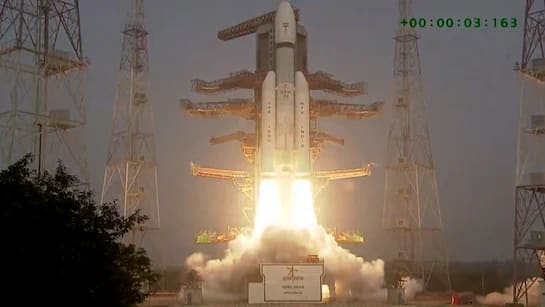
New Delhi: The Indian Space Research Organisation achieved a historic milestone on Wednesday. From the Satish Dhawan Space Centre in Sriharikota, ISRO launched the BlueBird Block-2 mission. The Bahubali LVM3-M6 rocket successfully placed the BlueBird Block-2 satellite of the American company AST SpaceMobile into a low Earth orbit. This is the heaviest payload ever carried by the LVM3 rocket, weighing 6100 kilograms.
ISRO's Mission Successful, PM Modi Praises the Achievement
The mission was launched at 8:54 AM IST from the second launch pad. The 43.5-meter-tall, 640-ton rocket released the satellite into a circular orbit at an altitude of 520 kilometers with a 53-degree inclination after a flight of approximately 15 minutes. Prime Minister Narendra Modi described ISRO's achievement as a moment of great pride. PM Modi called this achievement a major leap forward on 'X' (formerly Twitter).
Several Countries Failed in Their Missions
This is the sixth flight of ISRO's 100% successful LVM3 series, which has previously launched Chandrayaan-2, Chandrayaan-3, and 72 OneWeb satellites. The BlueBird Block-2 mission will bring about several significant changes in mobile network connectivity. This achievement by ISRO is particularly significant because several other countries faced major setbacks during similar space missions. They had made extensive preparations for their space missions, but suffered significant failures during the launch. Brazil, Japan, and South Korea are among the prominent examples. Accident During Launch in South Korea
South Korea's first commercial orbital rocket, Hanbit-Nano, crashed shortly after launch from Brazil. The incident occurred on Tuesday, according to Korean time, when the rocket's operator, Inspace, reported that it malfunctioned 30 seconds after launch and fell to the ground. Fortunately, the rocket landed in a safe area, and there were no reports of casualties or additional damage. The launch took place from the Alcântara Space Center in Brazil. According to Inspace, the rocket was carrying five satellites that were to be placed in a low Earth orbit at an altitude of 300 kilometers.
Major Accident During Launch in Brazil
Earlier, a shocking incident involving a major accident during a special mission launch occurred in 2003 at the Alcântara Space Center in Brazil. The VLS-1 V03 rocket exploded on the launch pad a few days before its scheduled launch. This tragic incident claimed the lives of 21 scientists and technicians. This dealt a severe blow to Brazil's space program. This was not an isolated incident.
Rocket Malfunction Before Mission, Japan Suffers Setback
A similar accident occurred in Japan in March 2023 when the H3 rocket malfunctioned. This incident took place on March 7, 2023, when the H3 rocket's engine failed to ignite during the second stage of its launch. As a result, it could not reach its intended orbit. Consequently, Japan's ALOS-3 satellite was destroyed, and the launch failed. This was a significant setback for Japan's space program.





Discussion (0)
Leave A Reply
Speak Truth To PowerModerated by Times Indian