

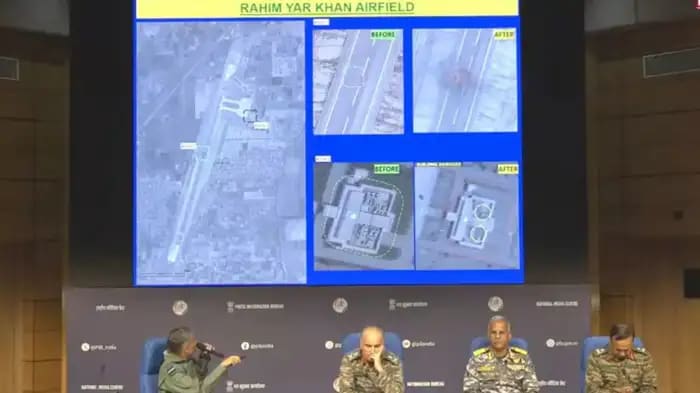
New Delhi: Even though the tension between India and Pakistan seems to be decreasing, the Indian Army is still in active mode. How much loss did Pakistan suffer in the recently conducted 'Operation Sindoor' was given in the DGMO's press conference. The press conference started with Shiv Tandav. During this, Indian Army's Director General of Military Operations (DGMO) Lieutenant General Rajiv Ghai said that the purpose of Operation Sindoor was to eliminate terrorists. We killed 100 terrorists. Along with this, many terrorist hideouts were also targeted. He also showed evidence of this.
9 terrorist hideouts destroyed, so many terrorists killed
DGMO Lieutenant General Rajiv Ghai said that Operation Sindoor was planned after the attack on tourists in Pahalgam. The clear military objective of this operation was to destroy the terrorists and their hideouts. We deeply identified the terrorist camps across the border. However, many hideouts there were already evacuated. During this time, we got concrete information about 9 such hideouts where terrorists were hiding. When our agencies declared these hideouts as active, action was taken. In which more than 100 terrorists were killed.
Many high value targets like terrorist Yusuf Azhar became targets
DGMO said that during this operation, many hideouts were in Pakistan Occupied Kashmir (PoK) and some in Punjab province of Pakistan. This also included the Muridke camp, from where terrorists like Kasab and David Headley had connections. More than 100 terrorists were killed in our strike. These include high value targets like Yusuf Azhar, Abdul Malik Rauf and Mudassir Ahmed. These terrorists were associated with the IC 814 hijack and Pulwama attack.
Pakistan tried to target our airfield, failed
General Rajiv Ghai said that Pakistan violated the ceasefire on the LoC and civilian areas like Gurudwaras were also targeted from their side. DGMO said that on the night of 8-9 May, Pakistani drones came to the border and targeted military bases, but most of them failed. Our air defense system failed them. Pakistan tried to target our airfield. We failed them. We strengthened our deployment further. 35-40 Pakistani soldiers were lost in artillery fire.
When a message from Pakistan's DGMO came on the hotline
The DGMO said that on the morning of May 10, a message came on the hotline in which Pakistan's DGMO asked to talk. We have decided to talk. We have again decided to talk on May 12, on the agreement that was reached. But the Pakistan Army violated the agreement within a few hours, to which a reply was given. The DGMO said that the agreement that was reached was to stop firing. Then tomorrow the modalities will be decided, but Pakistan violated it within a few hours. Let's see what happens tonight.
Pakistan Army did not cross the border
The DGMO said that the Pakistan Army did not cross the international border. There was definitely an attempt to infiltrate. It is difficult to say whether they were terrorists or Pakistani commandos, but their attempt was foiled. DGMO Lieutenant General Rajiv Ghai said that what happened is no less than a war. In normal circumstances, such air strikes do not happen, drone attacks do not happen.
How did the Air Force target the terrorist camps in Muridke and Bahawalpur?
Indian Air Force Director General Air Operations (DGAO) Air Marshal Avdhesh Kumar Bharti said that the Air Force precisely targeted the terrorist training camps in Muridke and Bahawalpur. The aim of the strike was achieved. There was a high value target in Bahawalpur. We did a precision strike. The DGAO said that we did not target any military base of Pakistan on the night of 6/7 May. But on May 7, Pakistan targeted our military base and civil area. Then we targeted their air defense system and radar.
The enemy carried out drone attack, tried to target civilians
The DGAO said that on the night of 8-9 May, drones came in large numbers from different directions. Our air defense was fully prepared. The difference between the night of May 7 and May 8 was that there were more drones on May 7 but there were more helicopters on May 8. These could have been for spying and to target civilians. In response, we again targeted Pakistan's military bases.
Pakistan's airbases, command centers, air defense systems were targeted
DGAO said that we targeted Pakistan's airbases, command centers, air defense systems on the entire border. We have the capability to target every base and every system of theirs. We did a balanced strike just to make them come to their senses. From the beginning, our fight was not with the Pakistani military or anyone else, our war was against terrorists. DGAO said that we have shot down some Pakistani jets but do not want to reveal the number right now. We are in a combat scenario. There is always loss in this. We should see whether we achieved the target, destroyed the terrorist bases or not.
Indian Navy remained alert, this is how it stopped Pakistan
Indian Navy's Director General Navy Operations (DGNO) Vice Admiral AN Pramod said that after the Pahalgam terror attack, the Navy had deployed its assets. We also conducted tests in the sea for our operational readiness. The Navy forced the Pakistani Navy to stay in a defensive posture. They remained in their harbour the whole time.
Indian Army's press conference started with the tune of Shiv Tandava
Indian Army's Director General Military Operations (DGMO) Lieutenant General Rajiv Ghai, Indian Air Force's Director General Air Operations (DG Air Ops) Air Marshal Avdhesh Kumar Bharti and Indian Navy's Director General Naval Operations (DGNO) Vice Admiral AN Pramod attended the press conference. The special thing about this press conference was that the tune of Shiv Tandava was played at the beginning.


Discussion (0)
Leave A Reply
Speak Truth To PowerModerated by Times Indian