

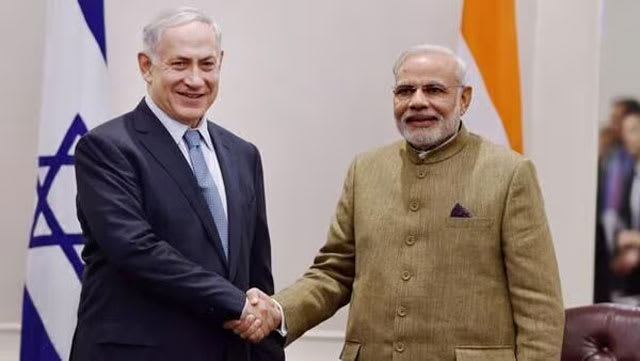
New Delhi: Prime Minister Narendra Modi is visiting Israel. His visit begins on February 25th. Ahead of that visit, Israel has proposed to India to form a six-party alliance to combat Islamic extremism. Israeli Prime Minister Benjamin Netanyahu has said that India should join this six-party alliance (Hexagon of Alliances) along with African and Arab countries.
Defense experts say that India is about to strike a deal with Israel that will be a powerful slap in the face for Pakistan. Israeli defense technology also destroyed several Pakistani targets during Operation Sindoor. Let's learn from experts what this alliance is and what its impact will be. We will also learn whether India should join this alliance.
What did the Israeli PM say?
Before the visit, the Israeli Prime Minister called Modi a dear friend. Speaking on the growing strategic coordination between the two countries, he said, "I spoke about my dear friend Prime Minister Narendra Modi's historic visit to Israel this coming Wednesday."
Describing this relationship as a powerful alliance between two global leaders, Netanyahu said that Israel and India are partners in innovation, security, and a shared strategic vision.
What should a six-party alliance look like?
According to the Times of Israel, Netanyahu said, "The vision I have is that we will create a holistic system, essentially a 'six-party' alliance, within or around West Asia.
Our aim is to create a pole of nations that are aligned on the realities, challenges, and goals of the radical poles, whether it is the radical Shia pole, which we have strongly attacked, or the emerging radical Sunni pole." What is the Hexagon Alliance? Know it first.
According to Netanyahu, it is a six-party alliance of countries in and around West Asia.
This alliance includes India, Greece, Cyprus, and some other unnamed Arab, African, and Asian countries.
According to a PTI report, this alliance will be similar to the IMEC (India-Middle East-Europe Economic Corridor) concept, which aims to accelerate economic development by promoting connectivity.
This hexagon of alliances will coordinate on three aspects: economic cooperation, diplomatic coordination, and security cooperation.
Netanyahu sees this bloc as a counterbalance to Iran and its proxy network, often referred to as the "Axis of Resistance."
He stressed, "All these countries have different perspectives, and our cooperation can yield great results and can certainly ensure our strength and our future."
India, a secular country, will distance itself from the Hexagon Alliance.
According to defense expert Lieutenant Colonel (Retd.) JS Sodhi, India and Israel have been friends for a long time. Both India and Israel have been victims of extremist attacks.
Israel and India should have a strong defense deal. The proposal made by Netanyahu is against radical Shia or Sunni. Since India is a secular country, India would not want to join such a Hexagon Alliance.
A Slap in the Face for Pakistan
According to defense expert Lieutenant Colonel (Retd.) JS Sodhi, India and Israel can develop a defense relationship that would be helpful to each other during war or aggression.
If such an alliance or deal is reached, it would be a slap in the face for Pakistan. Pakistan thinks it has achieved a major milestone by entering into a military alliance with Saudi Arabia.
Defense Expert JS Sodhi
Hamas Spokesperson Rejects This Hypothesis
Hamas spokesman Hazem Qassem has rejected Netanyahu's plan for a 'six-party alliance,' calling it a 'direct threat to their strategic interests.'
According to a media report, Qassem said, "What is happening is an attempt to reshape the region in a way that serves only the interests of the occupying countries.
These moves are exploiting the weakness of Arab countries during the Gaza War. We urge Arab countries to recognize the dangers of these plans and their adverse consequences for the security and stability of the region."
Modi and Netanyahu Call Each Other Special Friends
PM Modi is visiting Israel on Wednesday, his second visit since 2017. This visit comes just months after a ceasefire between Israel and Hamas following a two-year war in Gaza.
The relationship between the two Prime Ministers will receive special attention, as Netanyahu has described Modi as a personal friend, saying they frequently speak on the phone and have visited each other's countries.
PM May Address Israeli Parliament
During his two-day visit, Prime Minister Modi is expected to address the Israeli Parliament, the Knesset, a rare honor. The two countries are also expected to further strengthen cooperation by signing agreements in areas such as technology cooperation, security cooperation, artificial intelligence, agriculture, water management, and trade.
Ballistic missile shields and laser weapons to be jointly developed
Sodhi reports that a major defense deal could be signed during PM Modi's visit to Israel. There are also talks that India is considering joint development of ballistic missile shields, laser weapons, drones, and long-range stand-off missiles with Israel. Additionally, talks could be reached on expanding cooperation on advanced systems like the Iron Dome, David's Sling, and Arrow.
What did PM Modi say about Netanyahu's statement?
On Sunday, Prime Minister Modi thanked Netanyahu on X, saying, "Thank you, my friend, Prime Minister Netanyahu. I fully appreciate the bond between India and Israel and the diversity of our bilateral relations."
India deeply values our unwavering friendship with Israel, which is based on trust, innovation, and a shared commitment to peace and progress. I look forward to our discussions during my upcoming visit to Israel.

Discussion (0)
Leave A Reply
Speak Truth To PowerModerated by Times Indian